
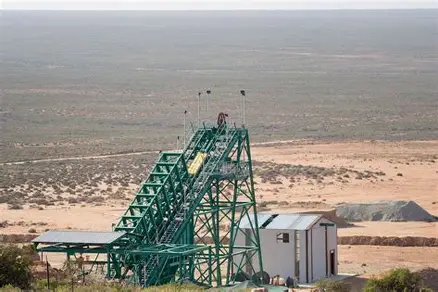
The United States has decided to support a major rare earth extraction project in South Africa, highlighting the strategic priority of securing critical minerals despite political tensions between Washington and Pretoria.The initiative focuses on the Phalaborwa project, located in the Limpopo province, where old mining waste deposits could become a new source of metals that are essential to the global economy.
Washington is backing the project through the United States International Development Finance Corporation (DFC), which plans to invest 50 million dollars. The objective is clear: reduce American dependence on China, which currently dominates both the production and especially the refining of rare earth elements. These minerals are vital for the manufacturing of electric vehicles, wind turbines, industrial robots, advanced electronics, and defense systems.
The Phalaborwa site has a major advantage. The operation would not rely on opening a traditional new mine, but on processing around 35 million tonnes of phosphogypsum, a by-product from previous mining and chemical activities. This method could allow the recovery of strategic elements such as neodymium, praseodymium, dysprosium, and terbium, all highly sought after for the production of high-performance permanent magnets.
The project is being developed by Rainbow Rare Earths with the support of TechMet, a partner of the DFC. According to the developers, operations could begin in 2028, while the construction of a processing plant is expected to start in 2027.
Beyond the industrial dimension, this decision comes at a sensitive diplomatic moment between the two countries. The American administration recently froze certain financial aid programs to South Africa, reflecting a cooling of bilateral relations. Despite this, Washington has chosen to maintain its commitment to this mining project, showing that the global race for access to critical resources goes beyond current political disagreements.
Analysts believe the project could also strengthen South Africa’s position in global value chains linked to the energy transition. As worldwide demand for rare earths continues to rise, Pretoria could attract more investment in mineral processing, metallurgy, and clean technologies.
For the United States, the move is also a way to expand its economic presence in Africa, where China remains highly influential in the mining sector.
If successful, Phalaborwa could become a symbol of a new generation of mining: more circular, based on the recovery of existing industrial waste, less energy-intensive, and better aligned with global environmental goals. It would also represent a major geopolitical turning point in the international battle for the resources of the future.