
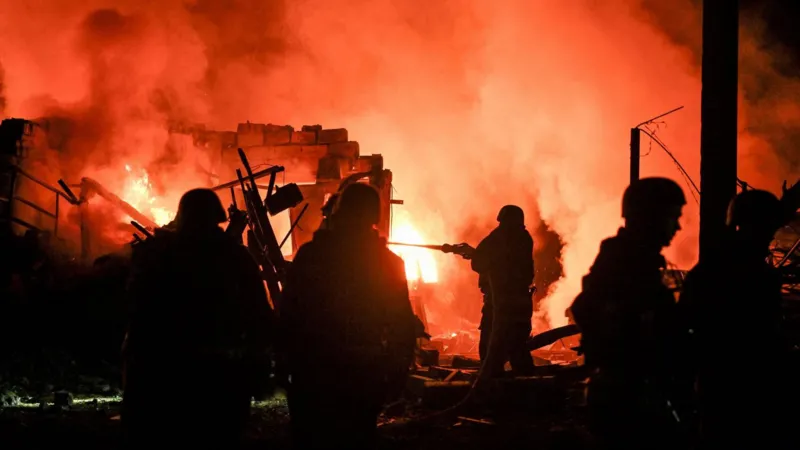
The war in Ukraine has entered a new phase of escalation following a series of deadly Russian strikes that Ukrainian President Volodymyr Zelenskyy says involved ballistic missiles supplied by North Korea. The attacks, which targeted several Ukrainian regions overnight on August 11, 2026, killed civilians and caused significant damage to industrial and civilian infrastructure. According to Ukrainian authorities, the southeastern city of Zaporizhzhia was among the hardest-hit areas, with a major strike on the Zaporizhstal steel plant killing seven workers and injuring at least 24 others.
Zelenskyy stated that Russian forces used several types of weapons during the attacks, including North Korean ballistic missiles, Russian Zircon hypersonic missiles and guided aerial bombs. The Ukrainian president described the use of North Korean missiles as another indication of the growing military cooperation between Moscow and Pyongyang. Russia has acknowledged carrying out strikes in Ukraine but has not confirmed that North Korean missiles were used in the latest attacks.
The strikes were not limited to Zaporizhzhia. Kyiv and other Ukrainian regions were also targeted. Explosions were reported in the capital during the night, while emergency services dealt with fires and damage to infrastructure. In the Dnipropetrovsk region, civilians were also killed and injured. Taken together, the attacks resulted in at least ten civilian deaths across Ukraine, according to Ukrainian authorities and international media reports.
The attack on the Zaporizhstal steel plant is particularly significant because the facility is one of Ukraine’s major industrial sites. The Russian Ministry of Defense claimed that the plant was involved in the production of materials linked to Ukraine’s military-industrial sector. Ukrainian authorities, however, reported that the strike hit the facility while workers were attempting to reach shelters. Production was halted, while surrounding buildings and infrastructure were also damaged.
The alleged use of North Korean ballistic missiles is part of a broader and increasingly strategic relationship between Russia and North Korea. Moscow and Pyongyang significantly strengthened their military partnership after signing a comprehensive strategic partnership treaty in 2024. Since then, North Korea has reportedly provided Russia with substantial quantities of ammunition and ballistic missiles to support its war effort in Ukraine.
Western and Ukrainian officials have repeatedly warned that North Korean military assistance could allow Russia to maintain the intensity of its attacks despite the prolonged conflict. In recent weeks, Ukrainian intelligence reported that a North Korean missile unit had begun deploying in western Russia. According to Ukrainian assessments cited by Reuters, the unit could be equipped with up to 120 ballistic missiles and six launchers.
The development is particularly concerning for Ukraine because ballistic missiles are among the most difficult weapons to intercept. Their high speed and flight trajectory require sophisticated air-defense systems, including advanced Western systems such as the Patriot. Ukraine has repeatedly warned that it is facing shortages of high-end air-defense interceptors as Russia increases its use of ballistic missiles.
Zelenskyy has also warned that Moscow may receive additional North Korean military support in the coming months. On August 9, he said that between 30,000 and 50,000 North Korean personnel could be deployed on Russian territory. He did not provide details about the source of this intelligence, but his statement reflects Kyiv’s growing concern over the scale of North Korea’s involvement in the conflict.
North Korea’s involvement is not limited to weapons. Pyongyang has previously deployed troops to support Russian forces, particularly during fighting around Russia’s Kursk region. North Korean soldiers have reportedly participated in combat operations alongside Russian forces. For Pyongyang, involvement in the war provides an opportunity to gain direct battlefield experience, while Russia can benefit from additional manpower and military supplies.
This cooperation could have consequences well beyond the Ukrainian battlefield. Zelenskyy has argued that the war is providing North Korea with valuable experience in modern warfare and allowing it to improve its missile systems through real-world use. He warned that the longer North Korean weapons and personnel are used in Ukraine, the more opportunities Pyongyang has to identify weaknesses and improve its military capabilities. This could eventually increase security risks for countries such as South Korea, Japan and the Philippines.
The relationship is therefore increasingly viewed as a strategic exchange. Russia gains access to additional missiles, ammunition and personnel, while North Korea can potentially receive economic, technological and military benefits from Moscow. The battlefield itself becomes a testing ground where North Korean weapons can be evaluated under real combat conditions.
The latest attacks also demonstrate the increasingly international nature of the war. Russia is not fighting solely with its own military resources, while Ukraine continues to depend heavily on Western military assistance, particularly for advanced air-defense systems. This dynamic has transformed the conflict into a broader confrontation involving multiple countries and increasingly complex military supply chains.
At the same time, Ukraine has intensified its own attacks against Russian territory. Ukrainian drones have targeted Russian military, logistical and energy infrastructure, including facilities linked to the country’s oil industry. Russia has responded with further missile and drone attacks against Ukrainian cities and infrastructure. The cycle of attacks and retaliation continues to expand the geographical scope of the conflict.
For Moscow, the use of North Korean weapons would provide an additional source of missiles at a time when Russia is attempting to sustain a high tempo of strikes. For Kyiv, however, the development represents another serious challenge. Ukrainian air defenses must respond simultaneously to drones, cruise missiles, ballistic missiles and hypersonic weapons, placing significant pressure on already limited resources.
The latest events also raise questions about the prospects for peace. Zelenskyy has argued that Russia’s increasing military cooperation with North Korea demonstrates that Moscow is preparing for further escalation rather than moving toward a negotiated settlement. The continued arrival of weapons and personnel from Pyongyang could make the conflict more difficult to resolve by strengthening Russia’s ability to sustain military operations.
Nevertheless, the precise use of North Korean missiles in the latest attack remains an allegation from the Ukrainian side. Russia has confirmed that it carried out strikes against Ukrainian targets but has not publicly confirmed that North Korean ballistic missiles were used. Independent verification of the exact weapons used in the attacks remains important, particularly given the highly sensitive geopolitical implications of direct military cooperation between Russia and North Korea.
The August 11 attacks therefore highlight two major developments in the war. First, Russia continues to intensify its long-range strikes against Ukrainian cities and strategic infrastructure. Second, North Korea’s role in supporting Moscow appears to be expanding, potentially involving missiles, military personnel and technical cooperation.
The growing partnership between Moscow and Pyongyang could have long-term consequences for both European and Asian security. For Russia, North Korean support provides additional resources to sustain the war. For North Korea, the conflict offers access to battlefield experience and potentially greater military cooperation with a major nuclear power. For Ukraine and its Western allies, the development represents another challenge in an already complex security environment.
As the war continues, the international community will closely monitor the scale of North Korean military assistance to Russia and its impact on the battlefield. The latest strikes demonstrate that the conflict remains highly dynamic and that developments far beyond Ukraine’s borders—particularly the strengthening partnership between Moscow and Pyongyang—are increasingly shaping the course of the war.