
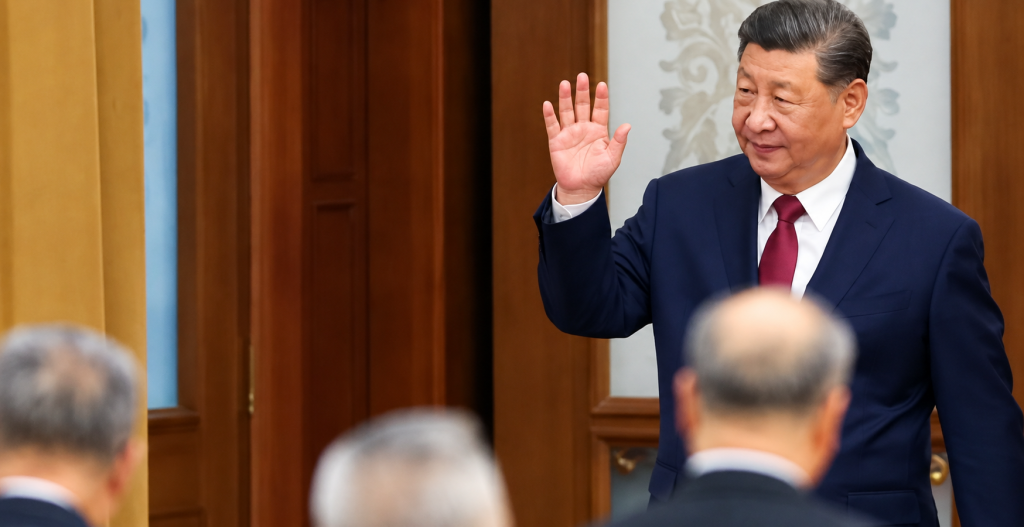
Chinese President Xi Jinping reaffirmed Beijing’s determination to oppose forces advocating Taiwan’s independence on Wednesday, September 30, 2026, during a reception in Beijing ahead of China’s National Day. His remarks came amid continued tensions across the Taiwan Strait and between China, Taiwan and the United States.
Speaking to around 800 guests gathered at the Great Hall of the People, Xi Jinping called for greater exchanges and cooperation between the two sides of the Taiwan Strait, while urging the country to “resolutely combat” separatist forces advocating Taiwan’s independence. He also rejected what Beijing describes as “external interference” in the Taiwan issue.
For the Chinese authorities, Taiwan is an integral part of China, and achieving “national reunification” remains a major political objective. Beijing says it favors peaceful development of relations across the Taiwan Strait, but has never ruled out the use of force to achieve its objectives. This position has for years been one of the main sources of tension between China and the United States.
Xi’s remarks also came just days after his meeting with U.S. President Donald Trump in Washington. According to Reuters, the Chinese leader had urged the United States to oppose Taiwan’s independence. The Taiwan issue therefore remains closely linked to relations between Washington and Beijing, particularly because of U.S. military and security support for the island.
China’s military pressure around Taiwan also remains an important element of the regional security environment. On October 1, Taiwanese authorities said they had detected 23 Chinese military aircraft, seven naval vessels and seven official ships around the island over the previous 24 hours. According to Taipei, 16 of the aircraft had crossed the median line of the Taiwan Strait and entered different areas of Taiwan’s air defense identification zone.
In his speech, Xi Jinping nevertheless linked the Taiwan issue to a call for maintaining peace and developing relations between the two sides. He also presented China’s foreign policy as being aimed at contributing to greater stability in an international environment that Beijing describes as increasingly uncertain and undergoing profound changes.
The latest statement highlights Beijing’s dual approach: officially promoting dialogue and exchanges with Taiwan while maintaining a particularly firm position toward independence movements and foreign involvement in the Taiwan issue. Taiwan therefore remains one of the most sensitive security issues in the Asia-Pacific region and a major factor shaping relations between China and the United States.