
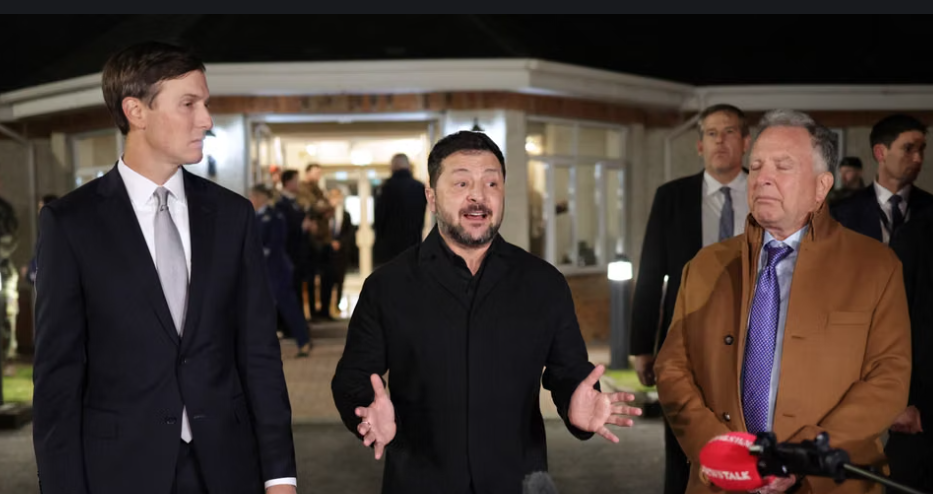
Speaking to journalists, Volodymyr Zelensky explained that American representatives had raised the question of whether Ukraine would agree to withdraw its forces from Donbas if it were granted NATO membership. This strategically important region in eastern Ukraine, which includes the territories of Donetsk and Luhansk, has been one of the main areas of confrontation between Kyiv and Moscow for several years. A significant part of the region is currently occupied by Russian forces, while the Ukrainian military continues to control certain areas.
However, the Ukrainian president reiterated that his country was not prepared to surrender its territories to Russia. He stressed that any discussion about a potential military withdrawal must be accompanied by credible security guarantees capable of protecting Ukraine against future aggression. For Kyiv, NATO membership would represent a major strategic safeguard, as Article 5 of the Alliance’s founding treaty provides for collective assistance to a member state subjected to an armed attack.
Nevertheless, Volodymyr Zelensky did not entirely rule out the possibility of submitting a potential agreement to the Ukrainian population. He indicated that a comprehensive proposal could be presented to citizens through a referendum, provided that it included concrete security guarantees, a sufficiently strong and adequately funded Ukrainian army, as well as resources dedicated to the country’s reconstruction. This condition is particularly important, given that four years of full-scale war have severely damaged Ukraine’s infrastructure, economy and public finances.
This diplomatic prospect nevertheless faces several major obstacles. Russia has long opposed Ukraine’s accession to NATO, viewing such a development as a threat to its strategic interests. Russian President Vladimir Putin has repeatedly described the expansion of the Atlantic Alliance as one of the reasons behind Moscow’s policy towards Ukraine. Under these circumstances, even a potential American proposal does not guarantee that Moscow would accept an agreement based on Ukraine’s integration into the Alliance.
Meanwhile, the latest negotiations held in Abu Dhabi ended without any major breakthrough towards a definitive settlement of the conflict. However, the discussions reportedly resulted in an agreement in principle on a prisoner exchange that could involve more than 1,000 people, according to statements by Volodymyr Zelensky. By contrast, no significant progress was announced regarding a possible ceasefire targeting energy infrastructure.
At the same time, European leaders are seeking to strengthen their involvement in discussions about Ukraine’s future. Following the European summit held in Dublin, European Union countries agreed that France, Germany, Italy, Poland and the United Kingdom would represent Europe in future negotiations, alongside European institutions. This decision reflects the Europeans’ determination to participate directly in discussions that could shape the continent’s future security arrangements.
Consequently, the prospect of a Ukrainian withdrawal from Donbas in exchange for NATO membership opens a particularly sensitive new diplomatic chapter. Caught between protecting its territorial integrity, securing lasting security guarantees and navigating international negotiations, Ukraine faces major strategic decisions. For now, no formal proposal has been converted into an agreement, and Kyiv’s position remains clear: any path towards peace must include solid guarantees to prevent the conflict from resuming in the future.
