
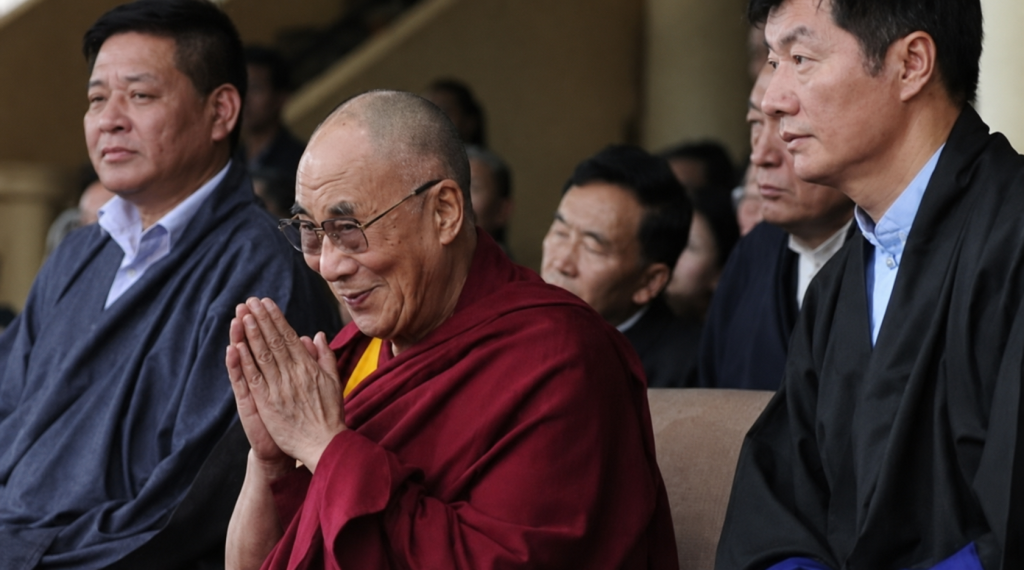
The Dalai Lama attended the swearing-in ceremony of the Tibetan government-in-exile on Tuesday in Dharamsala, northern India. The official event, held at the Namgyal Monastery, brought together Tibetan political leaders, Buddhist religious representatives, and members of the Tibetan diaspora to mark the beginning of the new mandate of the Central Tibetan Administration.
During the ceremony, Penpa Tsering was sworn in for a second term as Sikyong, the political leader of the Tibetan government-in-exile. Re-elected with a strong majority of votes cast by Tibetans living in dozens of countries, he will lead the administration for the next five years. In his speech, he pledged to continue diplomatic and political efforts aimed at defending the rights of the Tibetan people while strengthening unity within the exile community.
The Dalai Lama, now 90 years old, appeared smiling and in good health during the ceremony. As one of the world’s most respected spiritual leaders and the central figure of Tibetan Buddhism, he remains a symbol of the Tibetan people’s peaceful struggle since fleeing to India in 1959 following the failed uprising against Chinese rule in Tibet. For decades, he has advocated for a peaceful resolution with Beijing through the “Middle Way Approach,” which seeks genuine cultural and religious autonomy for Tibet rather than full independence.
In his remarks, Penpa Tsering reaffirmed his commitment to this non-violent approach supported by the Dalai Lama. He also stressed the importance of preserving the Tibetan language, culture, and traditions amid what Tibetan leaders describe as increasing pressure from Chinese authorities in the Tibet Autonomous Region.
Based in Dharamsala for more than six decades, the Central Tibetan Administration operates as a democratic government-in-exile with its own political institutions, parliament, and electoral system. Although it is not officially recognized by any country, it continues to play a major role in representing the interests of Tibetans living abroad.
The ceremony comes at a time of continued diplomatic tensions between Chinese authorities and Tibetan representatives. Beijing considers the Dalai Lama a separatist figure, while he continues to publicly advocate for a peaceful and negotiated solution to the Tibetan issue. Despite the absence of formal talks in recent years, Tibetan leaders in exile say they remain open to dialogue with China.
The event also represents a symbolic moment for the Tibetan community, which continues to preserve its political and cultural identity in exile while seeking to keep international attention focused on the situation in Tibet.