
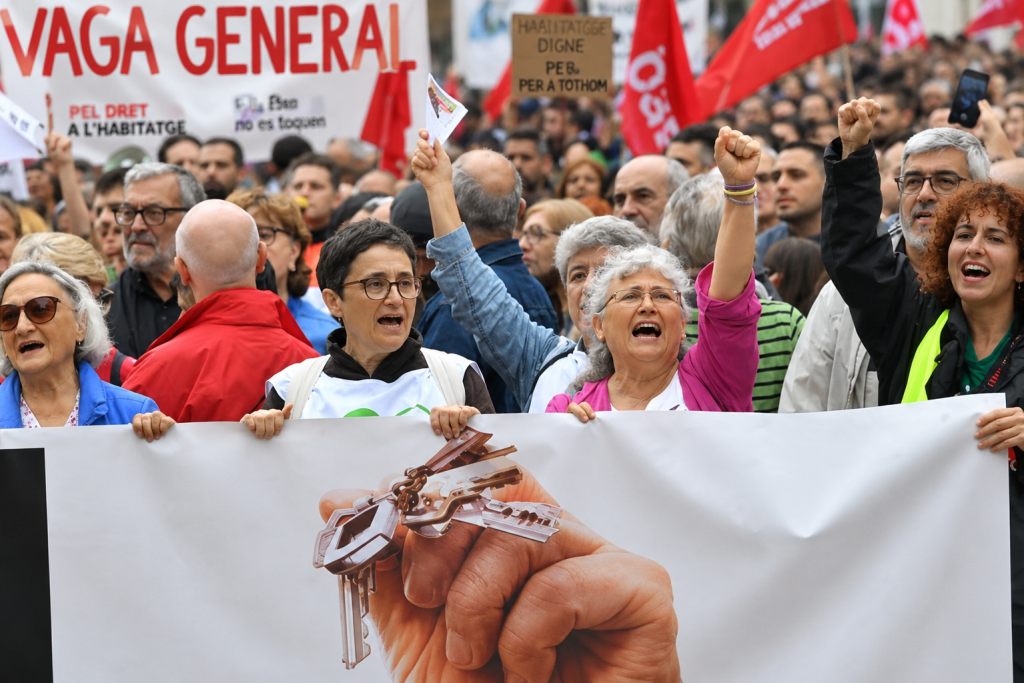
Tens of thousands of people took to the streets in Madrid and more than 50 other Spanish cities on Saturday, October 3, to demand more affordable housing amid rising rents, a shortage of accessible homes and a growing number of evictions. The demonstrations came one day after Spain’s parliament rejected two emergency measures proposed by Prime Minister Pedro Sánchez’s government to strengthen protections for tenants.
In Madrid, large crowds marched through the capital before gathering in the city center. Protesters denounced steadily rising rents and called on the authorities to take stronger measures to ensure that households, particularly young people and lower-income families, can access decent and affordable housing. Estimates of the turnout differed sharply: authorities put the number of demonstrators at around 70,000, while organizers claimed that as many as 500,000 people had taken part.
The protests were not limited to the capital. Demonstrations were also held in numerous cities, including Barcelona, Valencia, Seville and Bilbao. Tenant organizations are calling for lower rents, more public housing and stronger protection against evictions. They have also criticized the impact of short-term tourist rentals and the pressure exerted by some investors on the housing market.
The protests gained further momentum following the eviction of 87-year-old Madrid resident Maricarmen Abascal, who had lived in her apartment for several decades. Her eviction, which followed a substantial rent increase requested by the new owner, became a symbol of Spain’s housing crisis. Following strong public pressure, an agreement was eventually reached allowing her to return to her home. Her case nevertheless highlighted the difficulties faced by many tenants dealing with sharp rent increases and eviction proceedings.
The demonstrations also took place against a backdrop of political tensions. On Friday, Spain’s Congress of Deputies rejected two decree-laws put forward by the government. The measures included plans to extend until 2030 certain protections for vulnerable households facing eviction, strengthen regulations governing some seasonal and room rentals, and restrict certain real-estate operations involving large investors. Their rejection represented a setback for Pedro Sánchez’s minority government.
The vote also highlighted the government’s difficulty in securing a stable parliamentary majority. Right-wing and far-right parties opposed the measures, while several parties whose support is needed by the government did not vote in favor of them. The seven lawmakers from Junts per Catalunya played a particularly significant role in the defeat of the measures. The political debate centers in part on how best to address the housing crisis: the government and tenant organizations emphasize market regulation and stronger protections for renters, while opponents of the measures argue that the priority should be to increase the supply of housing.
Housing has become one of Spain’s most pressing social issues. In major cities, property prices and rents have risen significantly in recent years, while available housing has not always kept pace with demand. Tenant organizations have also criticized the conversion of part of the residential housing stock into tourist accommodation, as well as the growing presence of investors in certain real-estate markets.
The situation is particularly difficult for younger generations. For many households, a significant share of their income is now devoted to housing, reducing their ability to save or cover other expenses. The shortage of social housing is another major concern, with Spain having a relatively small public housing sector compared with several other European countries.
In Madrid, the protest movement has continued around Puerta del Sol, where activists have set up a camp to maintain pressure on the authorities. The organizations behind the demonstrations intend to continue their campaign and are considering further actions to push for measures addressing rents, evictions and the development of public housing.
The housing crisis has therefore become much more than a real-estate issue. It has emerged as a major social and political challenge in Spain, as the government seeks to balance tenant protections, the need to increase housing supply and the interests of homeowners and investors. The rejection of the government’s measures and the scale of the demonstrations nevertheless show that housing has become a central issue in Spain’s public debate.
