
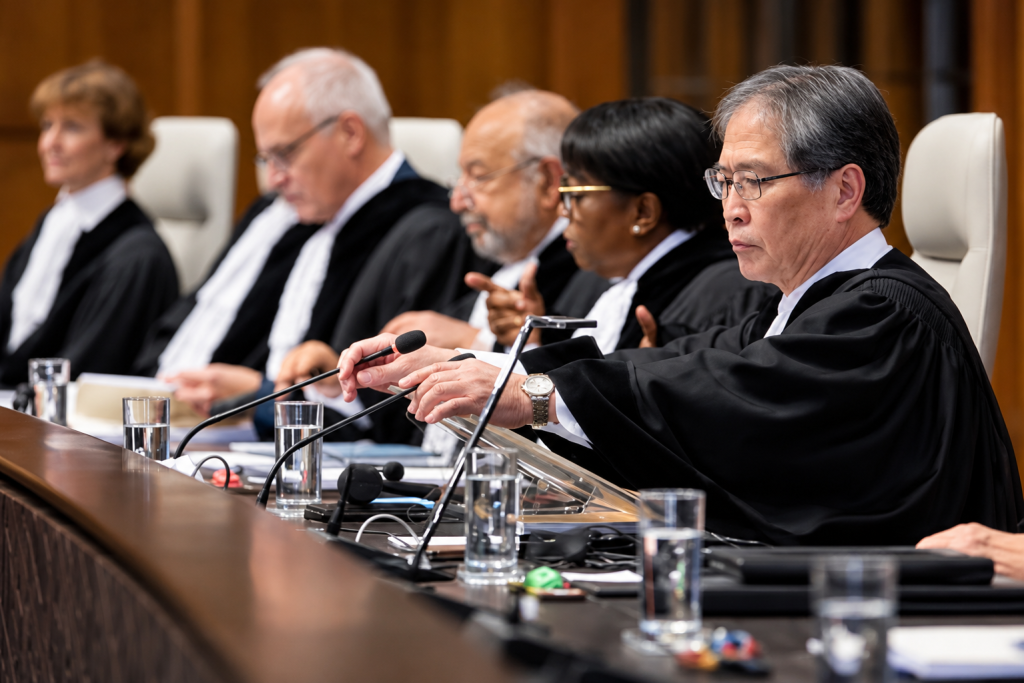
The International Court of Justice (ICJ), the principal judicial body of the United Nations (UN), is expected to deliver a highly anticipated ruling on Thursday, November 19, 2026, concerning allegations of genocide against Myanmar over the violence committed against the Rohingya Muslim minority. The decision, to be delivered at the Peace Palace in The Hague, Netherlands, could mark a major step towards the legal recognition of the atrocities suffered by this population and have significant implications for international law.
The case was brought before the ICJ by The Gambia on November 11, 2019, on behalf of the 57 member states of the Organisation of Islamic Cooperation (OIC). The West African country accuses Myanmar of violating the 1948 United Nations Convention on the Prevention and Punishment of the Crime of Genocide. The proceedings seek to establish Myanmar’s international responsibility for the violence committed against the Rohingya, rather than to determine the criminal liability of individual perpetrators.
The events date back in particular to August 2017, when the Myanmar military launched a major military operation in Rakhine State, in the country’s northwest. The offensive was accompanied by massacres, sexual violence, village burnings and widespread destruction of homes. According to the United Nations, the violence reportedly killed at least 10,000 people and forced more than 700,000 Rohingya to flee to neighbouring Bangladesh. A large proportion of the survivors sought refuge in the Cox’s Bazar camps, where hundreds of thousands of people continue to live in particularly difficult conditions.
Beyond recognising the suffering of the victims, the ICJ’s ruling carries considerable legal significance. The judges will examine whether the acts committed against the Rohingya meet the legal definition of genocide established under the 1948 Convention. One of the central issues will be determining whether there was a specific intent to destroy, in whole or in part, a national, ethnic, racial or religious group. This intent is one of the most difficult elements to establish legally, as it cannot be inferred solely from the scale of the violence. The judges will therefore assess the available evidence, the conduct of the armed forces and the various forms of persecution and destruction suffered by this minority.
The implications of the ruling also extend beyond Myanmar. It could help clarify the legal criteria used to establish genocide and influence other international proceedings. Particular attention is being paid to the case brought by South Africa against Israel before the same court. Pretoria accuses Israel of violating the Genocide Convention in connection with its military offensive in the Gaza Strip. Although the two cases are separate, the legal principles developed in the Rohingya case could serve as a reference in future deliberations before the Court.
The proceedings are also taking place amid growing tensions surrounding the independence of international justice. In recent weeks, several American officials and prominent figures have stepped up their criticism of the ICJ and some of its judges. The Court’s president, Japanese judge Yuji Iwasawa, was notably targeted in an editorial published by The Wall Street Journal on October 29, 2026. South African judge Navanethem Pillay, appointed to participate in the case brought by The Gambia against Myanmar, has also faced public criticism from the United States representative to the United Nations, Mike Waltz. These interventions have raised concerns among several international legal experts and officials, who warn that attempts to intimidate judges could undermine judicial independence.
Against this backdrop, the ruling expected on November 19 represents an important test of the authority and credibility of international justice. If the ICJ finds Myanmar responsible for committing genocide, its decision could strengthen efforts to secure justice for the victims, as well as calls for reparations and guarantees of non-repetition. The Court could also clarify Myanmar’s obligations regarding the prevention and punishment of genocide. Its judgments are final and without appeal, although their implementation depends, in particular, on the cooperation of states and international mechanisms.
For Rohingya refugees in Bangladesh, this decision represents a hope for recognition after years of persecution, forced displacement and uncertainty about their future. Beyond their immediate circumstances, the ruling could mark a decisive milestone in the fight against impunity and reaffirm that international law applies to all states, regardless of their political or military power.
