
Poland is facing a serious political and institutional crisis, marked by an increasingly bitter confrontation between Prime Minister Donald Tusk’s government and nationalist President Karol Nawrocki. At the centre of the dispute is the Constitutional Tribunal, the country’s highest constitutional court, responsible for ensuring that laws comply with the Constitution. The conflict, which has been developing for several years, reached a new level on Friday, October 30, 2026, when the court’s president was suspended and police forces intervened at the institution’s headquarters in Warsaw.
The roots of the crisis lie in deep disagreements over the appointment of constitutional judges and the independence of the judiciary. Since 2015, the Constitutional Tribunal has become a major battleground between conservative political forces and those advocating reforms to the judicial system. Under the Law and Justice party (PiS), which governed Poland between 2015 and 2023, several judicial reforms sparked criticism over the politicisation of state institutions and the weakening of judicial independence. These changes also triggered tensions with the European Union, which repeatedly raised concerns about the deterioration of the rule of law in Poland.
Since taking office in 2023, Donald Tusk’s pro-European coalition government has sought to restore judicial independence and reverse some of the measures introduced by its predecessor. However, these efforts have faced strong opposition from President Karol Nawrocki, who is politically aligned with conservative circles and the PiS party. The president has notably refused to receive the oaths of office of several judges elected by the parliamentary majority, further deepening the institutional deadlock.
The situation deteriorated significantly when Judge Anna Korwin-Piotrowska announced the suspension of Constitutional Tribunal President Bogdan Święczkowski and Vice-President Bartłomiej Sochański. She also claimed the authority to lead the institution on an interim basis. The decision immediately triggered a backlash from the opposition, which denounced what it considers an unlawful attempt to seize control of the court. The government, however, maintains that the measure is necessary to ensure the proper functioning of the Tribunal and safeguard its independence.
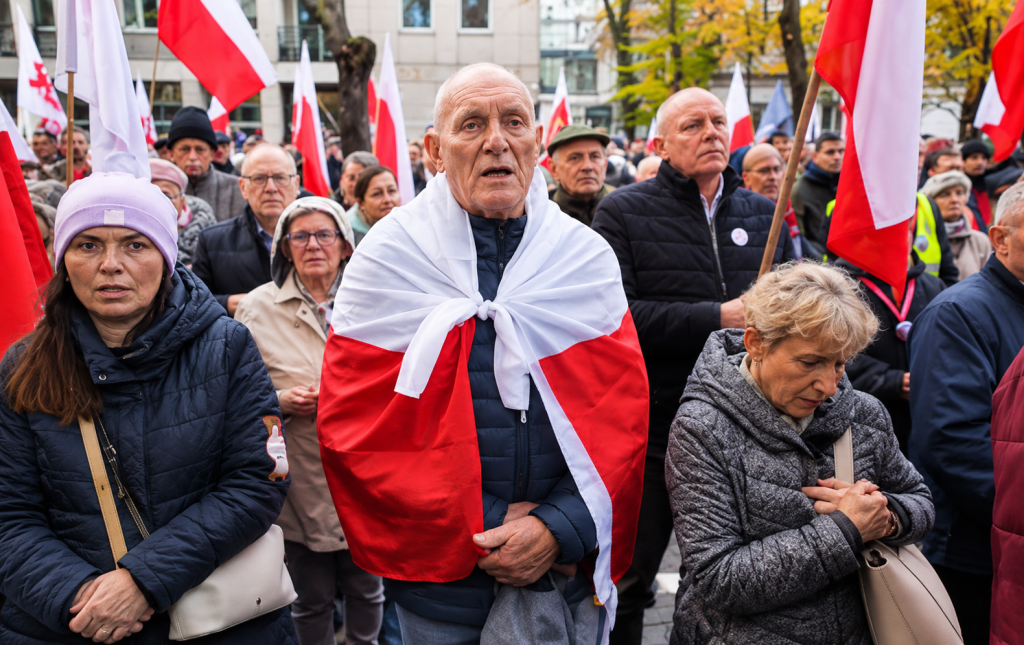
Police intervention further intensified the tensions. Riot police officers were deployed around the Constitutional Tribunal’s headquarters in Warsaw to secure access to the building. Several hundred demonstrators, including supporters of the PiS party, gathered outside to express their support for the suspended president. Clashes were reported as some protesters attempted to cross security barriers. According to reports in the international press, three people were arrested.
In response to the escalating situation, President Karol Nawrocki cut short his visit to Senegal and returned to Warsaw. He accused the government of attempting to take control of the country’s highest constitutional court. He also held consultations with representatives of various political parties in an effort to find a way out of the crisis. However, Prime Minister Donald Tusk did not take part in these discussions, highlighting the deep divisions between the two political camps.
The crisis has also attracted attention at the European level. The European Commission has called on the Polish president to recognise the new judicial appointments and contribute to restoring the normal functioning of the Constitutional Tribunal. Brussels is closely monitoring the situation, particularly given the previous disputes between Warsaw and European institutions over respect for the rule of law and judicial independence.
Beyond the confrontation between political leaders, the crisis represents a major challenge to Poland’s democratic stability. The lack of agreement over the legitimacy of judicial appointments and decisions risks further undermining public confidence in state institutions. It also comes at a politically sensitive moment, with the next parliamentary elections scheduled for less than a year away, amid growing political polarisation.
Ultimately, the dispute surrounding the Constitutional Tribunal goes far beyond the appointment of judges. It highlights Poland’s continuing difficulties in establishing a balance between the executive, legislative and judicial branches of government while safeguarding the principles of the rule of law. The outcome of this confrontation will be crucial not only for Poland’s political future but also for its relationship with the European Union.
