
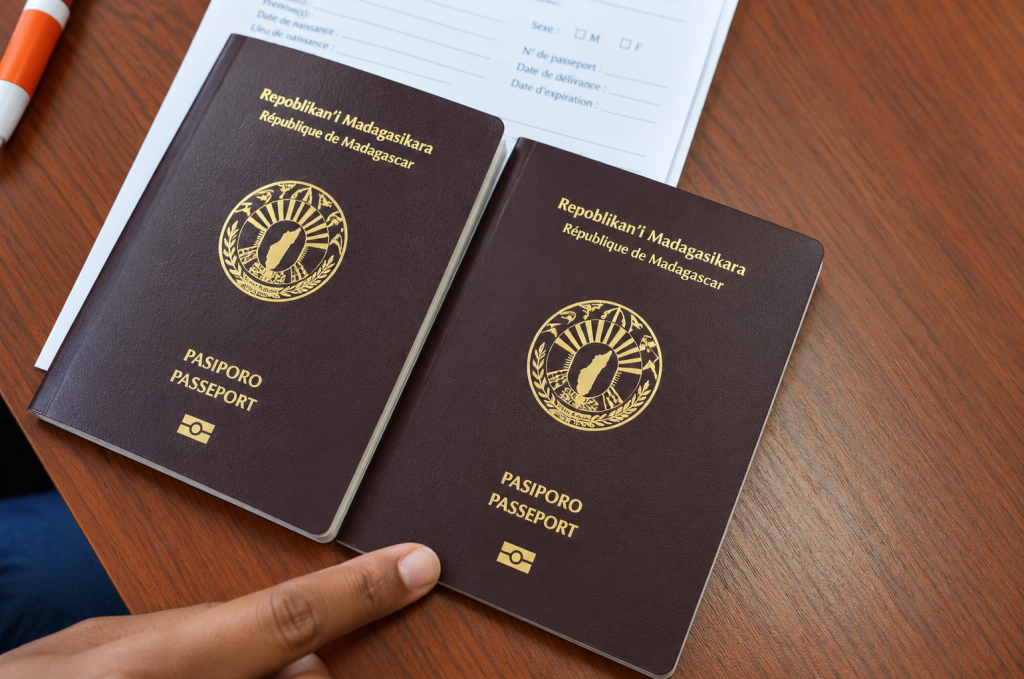
The cost of a Malagasy passport is expected to change as part of a reform aimed at extending the document’s validity period. Currently issued for 190,000 ariary, the passport could become more expensive under plans to extend its validity and modernize Madagascar’s passport issuance system.
The main reform concerns the passport’s validity period. At present, a Malagasy passport is valid for five years, but the government is considering extending this period to ten years. The principle of extending the validity period was approved by the Council of Ministers in August 2026. However, the final duration and the practical arrangements for implementing the reform have not yet been definitively established.
The Minister of Public Security, Police Inspector General Erick Michel Wouli Soumah Idrissa, said that the new passport fee had not yet been determined. He nevertheless confirmed that the current price would likely be revised because of the planned changes. The increase would notably be linked to the investments required to upgrade equipment and introduce new technologies into the passport production and issuance process.
According to the authorities, any increase in the passport fee would therefore not simply be the result of extending its validity. It would also reflect the technical developments required to modernize the system. The equipment used to produce passports needs to be upgraded in order to meet new technological and security requirements. The ministry has also stated that the Malagasy passport already complies with international standards, while technical work is underway to further strengthen the system.
The reform is also expected to affect administrative procedures. Authorities aim to improve the organization of services responsible for processing passport applications while continuing efforts to combat corruption. The objective is to make the issuance process more efficient and strengthen the reliability of the system. This modernization is particularly important because passports are essential documents for Malagasy citizens travelling abroad, whether for professional purposes, education, tourism or international mobility.
Improving facilities for applicants is another issue being considered by the ministry. Authorities are reportedly looking at providing larger premises in order to reduce overcrowding and improve conditions for citizens completing their administrative procedures. Infrastructure improvements are therefore expected to accompany the modernization of equipment and administrative processes.
Extending the passport’s validity could provide significant benefits to citizens. A document valid for up to ten years would, in principle, reduce the frequency with which people need to renew their passports and therefore limit the number of administrative procedures they have to complete. For frequent travellers, the reform could also make international travel arrangements easier by reducing the need for regular renewals.
However, the new fee is likely to be closely watched by the public. The current cost of 190,000 ariary already represents a significant expense for some households, particularly when several members of the same family need to obtain or renew their passports. A price increase could therefore affect access to the document, even if its validity period is substantially longer. The government will consequently need to strike a balance between the costs of modernizing the system and the need to keep the service affordable for citizens.
At this stage, it is important to emphasize that the new passport fee has not yet been announced and the reform has not yet entered into force. Passports issued under the current regulations remain valid for five years. Citizens should therefore continue to follow the existing procedures until the new regulations are officially implemented.
The planned reform of Madagascar’s passport system is therefore a broader modernization project involving several areas: extending the document’s validity, upgrading technology, improving administrative procedures, strengthening security and improving facilities for applicants. Its implementation will still need to clarify the new fee, the exact validity period and the timetable for the reform. For citizens, the key question will be whether any additional cost is ultimately offset by fewer renewal procedures and a more efficient public service.