
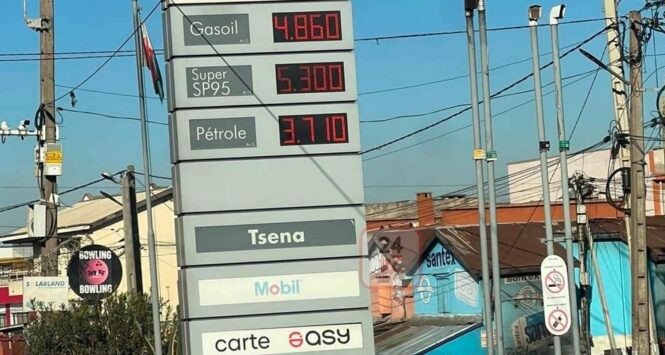
The price of super petrol has increased again in Madagascar. Since Saturday, September 5, 2026, a liter of super petrol has been sold for 5,300 ariary, up from 5,100 ariary, representing an increase of 200 ariary per liter. The adjustment applies only to super petrol. The prices of diesel and kerosene remain unchanged at 4,860 ariary and 3,710 ariary per liter, respectively.
The new pricing comes at a particular time for Madagascar’s fuel sector. It notably marks the return of the automatic fuel price adjustment mechanism, after several months during which its implementation had been suspended due to the country’s energy situation.
The 200-ariary increase represents a rise of approximately 3.9% in the price of super petrol. For motorists using petrol-powered vehicles, the increase directly affects the cost of travel. The more fuel a driver consumes and the more frequently they fill up, the greater the impact on their transportation budget.
To illustrate the impact, a motorist purchasing 20 liters of super petrol must now pay 106,000 ariary, compared with 102,000 ariary under the previous price. For a 40-liter tank, the cost reaches 212,000 ariary, which is 8,000 ariary more than before. For 50 liters, the cost rises to 265,000 ariary, compared with 255,000 ariary previously.
However, the price adjustment does not affect all petroleum products. Diesel remains at 4,860 ariary per liter. This stability is particularly significant for the transport sector, as many freight vehicles, passenger vehicles and professional vehicles run on diesel. Maintaining the current diesel price therefore prevents, for the time being, a direct increase in fuel costs for a significant portion of transport operators.
Kerosene also remains at 3,710 ariary per liter. The stability of this product is important for households that continue to use it for certain domestic and energy needs, particularly in areas where access to electricity or alternative energy sources may be more limited.
The increase in the price of super petrol comes after a period marked by several exceptional measures in Madagascar’s energy sector. In April 2026, the authorities declared an energy emergency amid difficulties affecting the sector. This decision notably led to the suspension of the automatic fuel price adjustment mechanism.
During this period, changes in pump prices were largely determined through administrative decisions. An increase of 200 ariary per liter was introduced in May 2026. However, this increase was presented as a temporary administrative measure rather than as a result of the automatic adjustment mechanism.
The situation subsequently changed with the reinstatement of the automatic adjustment mechanism by decree in July 2026. The mechanism is designed to allow fuel prices to be adjusted according to various economic factors and conditions affecting the supply of petroleum products.
The return of this mechanism means that pump prices can once again change in line with the parameters established under the system. The September increase in super petrol therefore represents an important step toward the restoration of a more regular fuel pricing system.
The end of the energy emergency is another key factor behind this development. The exceptional measures introduced earlier in the year were not renewed in August 2026, allowing the automatic adjustment mechanism to progressively resume its role.
For households, the latest increase comes at a time when transportation expenses already represent a significant part of daily budgets. People who use their vehicles to commute to work, accompany family members, shop or carry out professional activities will now have to allocate slightly more money to fuel.
The economic impact of a fuel price increase can also extend beyond the amount paid by motorists at the pump. Fuel represents a significant operating expense for many businesses that rely on vehicles. Delivery companies, certain retailers, service providers and professionals who travel frequently may be affected, particularly when their vehicles run on petrol.
Higher transportation costs can also have indirect effects on the prices of certain goods and services. When a company’s transportation expenses increase, it may have to reassess its operating costs. In some sectors, part of the additional expense could eventually be passed on to customers.
However, this potential effect should be considered in light of the current situation. Since diesel prices have not increased, activities that primarily rely on diesel-powered vehicles are not directly affected by this particular adjustment.
The new pricing structure therefore creates different effects depending on the type of fuel used. Drivers of petrol-powered vehicles are directly affected by the increase, while diesel users and consumers of kerosene do not face a price change for the time being.
The adjustment also comes against the backdrop of international oil markets, which can experience significant fluctuations. Petroleum product prices are influenced by numerous factors, including international oil prices, supply costs, transportation expenses, exchange rates and various costs associated with the import and distribution of fuel.
The automatic adjustment mechanism is intended to take these different factors into account when determining fuel prices. Its reinstatement therefore means that pump prices could continue to change in the future depending on economic and energy market conditions.
For consumers, this makes future fuel price developments particularly important to monitor. A single increase in the price of super petrol may have a limited impact, but successive increases could gradually raise transportation expenses for households and businesses.
Conversely, favorable changes in certain economic factors or in international oil markets could also influence future prices. The automatic adjustment mechanism does not necessarily mean that prices will only increase; rather, it is intended to allow prices to respond to changes in the underlying economic and energy conditions.
The new fuel pricing structure therefore represents an important development in Madagascar’s energy policy. After several months marked by the suspension of the automatic mechanism, the energy emergency and various administrative measures, the country is entering a new phase with the return of fuel price adjustments.
For now, the change is clear: super petrol is now priced at 5,300 ariary per liter, while diesel remains at 4,860 ariary and kerosene remains at 3,710 ariary. Petrol vehicle owners are therefore the first consumers directly affected by the latest increase.
Beyond its immediate impact on motorists’ budgets, the development will be closely monitored because of its potential consequences for transportation costs, business expenses and, indirectly, the prices of certain goods and services. Future developments will depend in particular on the implementation of the automatic adjustment mechanism and economic and energy conditions in the coming months.