
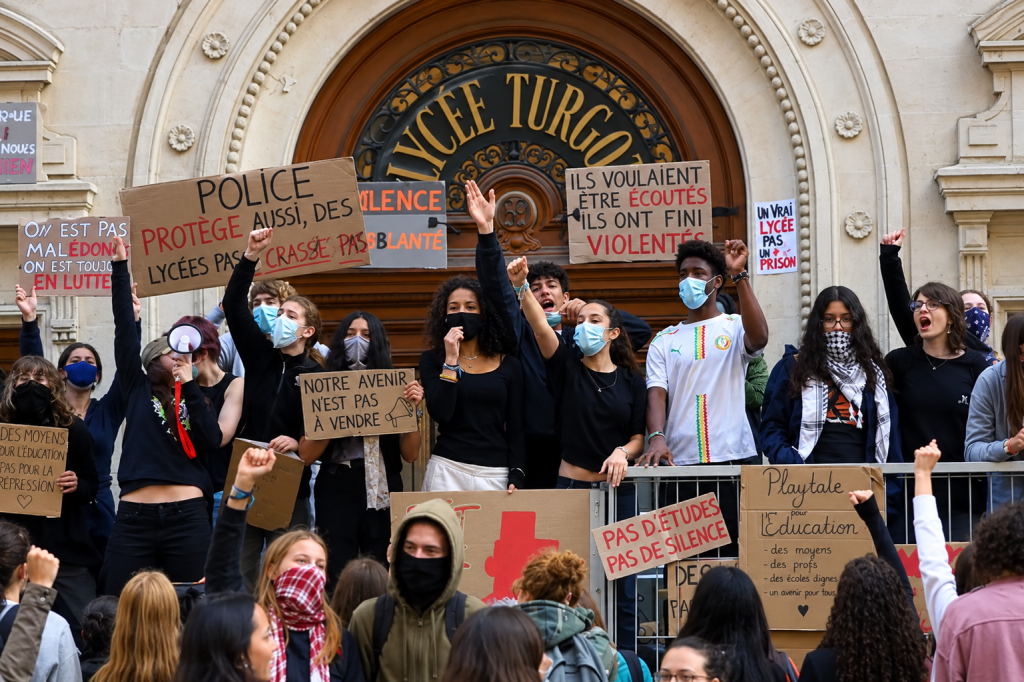
Student protests continued to disrupt high schools across France on Monday, October 5, despite a decline in the number of affected schools compared with the previous week. The movement, which began in mid-September, has continued to gain momentum and is increasingly marked by tensions between protesters and law enforcement. The day was particularly notable for a serious incident in Lens, in the Pas-de-Calais department, where a 15-year-old student suffered a severe hand injury during a gathering outside his high school.
According to initial information released by authorities, the teenager reportedly picked up a dispersal grenade used by police after projectiles had been thrown at officers. The device then exploded in his hand. However, the Béthune prosecutor stressed that the exact circumstances of the incident had yet to be established. Investigators have not determined with certainty whether the teenager actually picked up the grenade or whether it was thrown in his direction. An investigation by France’s General Inspectorate of the National Police (IGPN) has been launched to establish precisely what happened and determine whether any wrongdoing occurred.
The student was quickly treated by emergency services and transported to the regional hospital in Lille. His life is reportedly not in danger, but the severity of his injury has raised renewed concerns about the use of force during demonstrations involving minors. The Auguste-Béhal vocational high school in Lens, where the teenager is enrolled, announced that classes would be held remotely and that psychological support would be made available to students and staff affected by the incident.
The accident occurred against a backdrop of particularly tense protests. According to figures from France’s Ministry of Education, 413 schools were disrupted on Monday morning, compared with 564 at the same time on Friday, out of approximately 3,700 high schools across the country. Despite this decline, hundreds of schools remained affected by blockades, gatherings or interruptions to classes. The government wants teaching to resume wherever security conditions allow, but the movement is expected to continue on Tuesday, with student organizations calling for a third day of action.
The protesters’ demands focus mainly on educational conditions. Students are criticizing a lack of resources, deteriorating school facilities, overcrowded classrooms and teacher shortages caused by unfilled absences. In several disadvantaged areas, these difficulties are described as particularly severe. Students are also raising concerns about inequalities in the guidance and university admissions system, including the Parcoursup platform. The movement therefore reflects broader concerns about the quality of France’s public education system and the prospects available to young people.
However, the situation has become increasingly complicated by violence and property damage reported during some demonstrations. According to government figures, around 5,000 people have been arrested since the movement began, nearly 85% of them reportedly minors. Authorities have also recorded 24 schools that were set on fire or vandalized, as well as 78 members of the education staff who were injured. Several government officials argue that, in some locations, the protests have gone beyond the framework of a student movement and have developed into episodes of urban violence.
Trade unions and student organizations strongly dispute this interpretation. They argue that the violence should not overshadow the educational demands that initially sparked the protests and have criticized what they consider to be a disproportionate police response. The French League of Human Rights has referred to what it describes as a broader deterioration in respect for the rule of law, while several investigations by France’s police oversight authorities are underway into injuries sustained during demonstrations.
The government is nevertheless attempting to maintain dialogue with the protesters. Education Minister Édouard Geffray said that the new day of mobilization planned for Tuesday was a freedom that had to be respected and protected. Prime Minister Sébastien Lecornu, meanwhile, called for classes to resume wherever security conditions permit and announced several initiatives addressing concerns raised by students. However, student representatives said that a meeting held with government officials on Friday had failed to produce sufficiently concrete measures, prompting them to continue their mobilization.
Tuesday’s demonstrations could therefore represent another turning point. A broad alliance of education unions has called for support for the students, while the CGT trade union has announced that it intends to help supervise the demonstrations. Calls have also circulated on social media for a “black week,” with the possibility of new blockades being organized every day. The government is increasingly concerned that the movement could spread to university students and other sectors of society, particularly after several university campuses were already disrupted the previous week.
Beyond the blockades and confrontations, the protests reveal a deeper crisis surrounding France’s education system. Students are demanding greater resources and improved study conditions, while the government must simultaneously guarantee continuity in education and ensure safety around schools. The serious injury suffered by the student in Lens has intensified pressure on the authorities and could become a powerful symbol of the tensions surrounding the movement. As another nationwide day of action approaches, the government faces the difficult task of restoring dialogue with students while preventing violence and clashes from overshadowing the educational demands at the heart of the protests.