
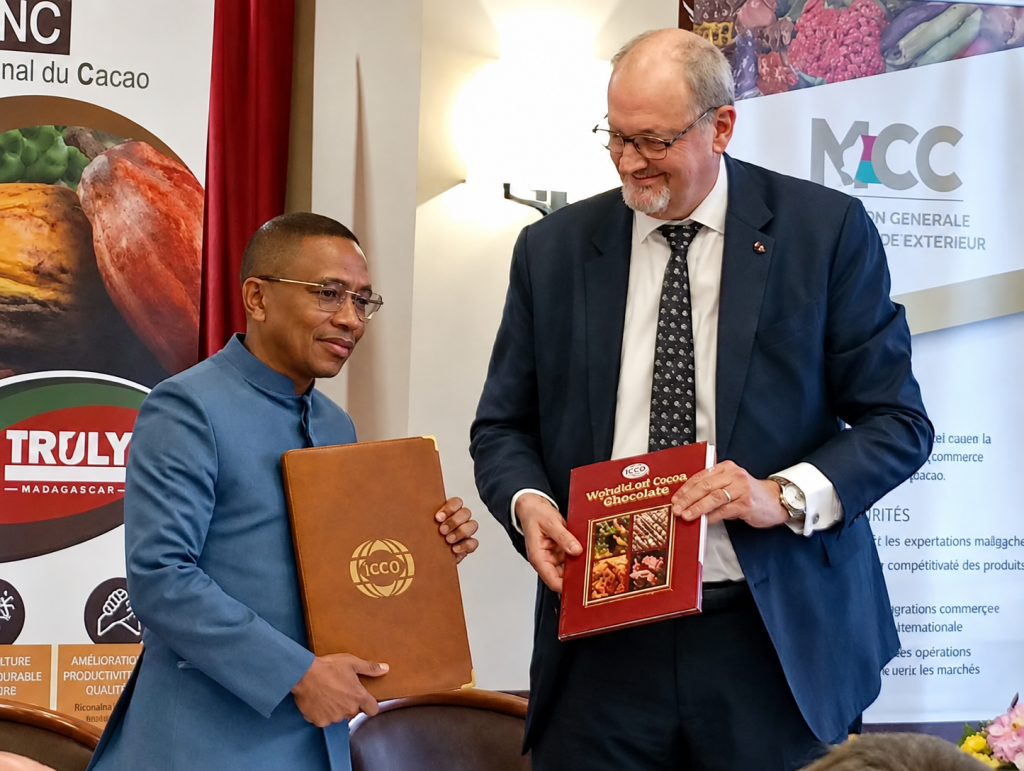
Madagascar is entering a new phase in strengthening its fine and aromatic cocoa sector. The 2026 International Cocoa Agreement was signed on August 27, 2026, at the Colbert Hotel in Antananarivo, in the presence of Prime Minister Mamitiana Rajaonarison and International Cocoa Organization (ICCO) Executive Director Michel Arrion. The signing reflects the Malagasy authorities’ determination to make better use of a product that already enjoys strong recognition on international markets.
With an annual production estimated at around 15,000 tonnes, Madagascar remains a relatively small producer on the global stage. However, the country has a major advantage: the distinctive quality and aromatic characteristics of its cocoa. The ICCO recognizes Madagascar as a producer of fine cocoa, while its 100% fine and aromatic cocoa stands out as a particularly distinctive product in Africa. This international reputation therefore represents significant potential for increasing the value generated by the sector.
The main challenge now is to turn this international recognition into tangible economic benefits for all stakeholders, particularly farmers. The sector provides livelihoods for approximately 45,000 Malagasy cocoa producers, whose incomes remain directly dependent on production conditions, prices and the country’s ability to secure greater value from its cocoa on international markets. For the authorities, improving farmers’ incomes is therefore one of the key objectives associated with the new agreement.
The signing of the agreement also marks the culmination of a decade of diplomatic and institutional efforts. Malagasy authorities have undertaken numerous initiatives and participated in international meetings to promote the specific characteristics of the country’s fine cocoa. The Ministry of Trade and Consumer Affairs, the National Cocoa Council and other stakeholders in the sector have contributed to efforts aimed at strengthening Madagascar’s position and defending its interests within the international cocoa industry.
Beyond international recognition, the next challenge will be to improve the sector’s competitiveness and productive capacity. The government aims both to preserve the exceptional quality of Malagasy cocoa and to increase production volumes. Achieving this objective will require stronger support for farmers, better production conditions and a more efficient organization of the value chain so that a larger share of the value created benefits local stakeholders.
This strategy is particularly important because quality is Madagascar’s main competitive advantage. In a highly competitive global market, the country cannot necessarily compete with major producers on volume alone. Promoting fine, aromatic and differentiated cocoa therefore appears to be a key strategy for increasing sector revenues, developing higher-value exports and strengthening Madagascar’s position in international markets.
The entry into force of the new agreement, scheduled for October 1, 2026, thus opens a new chapter for Madagascar’s cocoa sector. The real challenge will no longer simply be to obtain international recognition, but to translate that recognition into investment, higher production, better incomes for farmers and greater benefits for the national economy. For Madagascar, fine cocoa is now more than an export commodity: it represents an economic development opportunity that must be transformed into tangible results.