
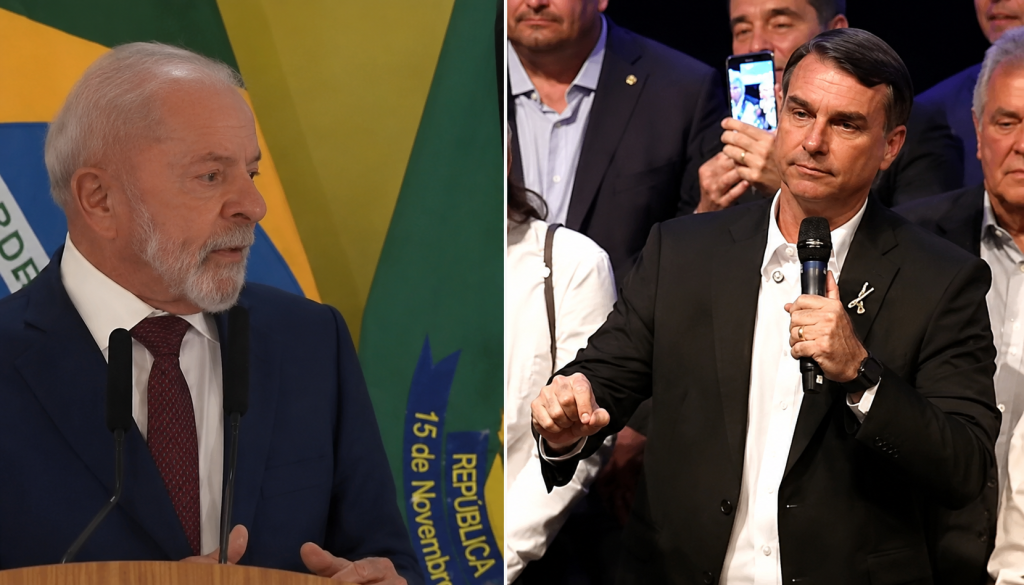
Brazil’s presidential campaign for the October 2026 election officially began on Sunday, August 16, amid a deeply polarized political climate. Incumbent President Luiz Inácio Lula da Silva, a historic figure of the Brazilian left, is facing Flávio Bolsonaro, senator and son of former President Jair Bolsonaro. The two men have emerged as the main contenders in an election that could be decided by a very narrow margin.
For Lula, the new campaign represents a major political challenge as he seeks another presidential term. He launched his campaign in São Bernardo do Campo, in the state of São Paulo, a location that holds strong symbolic significance given his political and trade-union background. Speaking to his supporters, Lula emphasized Brazil’s sovereignty, education, women’s rights, and the need to protect national interests in the face of foreign pressure.
Flávio Bolsonaro, meanwhile, officially launched his campaign on Copacabana Beach in Rio de Janeiro. The Liberal Party senator is relying heavily on his father Jair Bolsonaro’s political legacy while seeking to establish his own identity as a candidate. His campaign focuses primarily on public security, the fight against crime, and the defense of conservative values. He has notably pledged to intensify the fight against criminal organizations and to classify certain militias as terrorist organizations.
The confrontation comes as Jair Bolsonaro remains ineligible to run for office and under house arrest. Flávio Bolsonaro has therefore emerged as one of the main representatives of the Bolsonaro movement, which continues to enjoy significant support among part of the Brazilian electorate. His main challenge will be to expand his support beyond the core group of voters loyal to his father.
Opinion polls indicate that the race is becoming increasingly competitive. A CNT/MDA poll published on August 11 puts Lula at 42.4% in the first round, compared with 28.7% for Flávio Bolsonaro. In a potential second-round runoff between the two candidates, Lula would still hold the lead, with 48.0% against 39.1% for Flávio.
However, other surveys show a much closer contest. A Palver poll conducted in early August puts Lula and Flávio Bolsonaro at 46% each in a potential second round, while Lula leads 44% to 40% in the first round. These figures highlight the uncertainty surrounding the election and Flávio Bolsonaro’s potential to gain ground during the campaign.
Beyond voting intentions, the two candidates represent sharply contrasting political visions for Brazil. Lula emphasizes national sovereignty, social policies, education, and the protection of rights, while Flávio Bolsonaro places public security, the fight against crime, and conservative values at the center of his political platform.
The 2026 presidential election therefore represents more than a simple contest between two political figures. It marks another chapter in the deep polarization that has divided Brazil for several years between Lula’s political camp and the Bolsonaro movement. With the campaign now officially underway and polls showing a narrowing gap between the leading candidates, every vote could prove decisive before the October election.
Brazil’s presidential race is therefore shaping up to be a particularly close contest. Although Lula currently maintains a lead in several polls, Flávio Bolsonaro’s growing support shows that the outcome is far from certain. The coming months will be crucial for winning over undecided voters and, above all, for securing the support of the groups that could ultimately determine the outcome of the second round.