
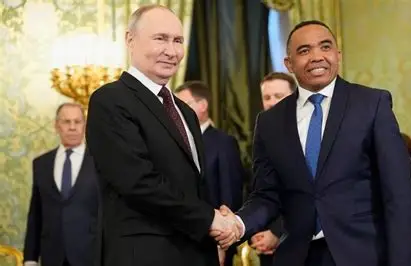
The official meeting held on February 20, 2026, in Moscow between Russian President Vladimir Putin and Madagascar’s transitional president Michaël Randrianirina marks a significant step in the evolution of bilateral relations between Russia and Madagascar. Beyond diplomatic formalities, the visit reflects a convergence of strategic interests within a global context shaped by shifting alliances and the diversification of partnerships across Africa.
For Moscow, strengthening ties with Antananarivo is part of a broader strategy to consolidate its presence on the African continent. Russia aims to expand its economic, security, and energy partnerships in response to growing geopolitical tensions and the need to diversify its international alliances. Madagascar, rich in mineral resources and strategically located in the Indian Ocean, represents both a geopolitical and economic opportunity. The sectors highlighted during discussions energy, mining, agriculture, education, and defense demonstrate an intention to anchor cooperation in long-term, structural areas of development.
From Madagascar’s perspective, this diplomatic outreach reflects a deliberate effort to diversify international partnerships. Facing persistent economic challenges, climate vulnerability, and significant infrastructure needs, the country is seeking new partners capable of providing financial, technical, and logistical support. Russia’s humanitarian assistance following recent cyclones — including the provision of equipment and aerial support underscores the practical dimension of this cooperation. It enables Antananarivo to address immediate needs while reinforcing a broader strategic dialogue.
Economically, bilateral trade remains modest on a global scale but holds considerable growth potential. Russian exports, primarily cereals and industrial products, could contribute to Madagascar’s food security, while Malagasy exports particularly agricultural goods and certain natural resources offer Russia alternative supply channels. This complementarity could pave the way for stronger trade flows, provided that logistical and financial mechanisms are further developed.
However, this evolving partnership also unfolds within a sensitive geopolitical environment. A closer alignment with Moscow may be interpreted as a strategic repositioning of Madagascar, especially in relation to its traditional partners in Europe, Asia, and multilateral institutions. Antananarivo will therefore need to maintain a balanced, multi-vector foreign policy to avoid excessive dependence on any single international actor.
Ultimately, the Moscow visit represents more than a symbolic diplomatic engagement. It signals a mutual willingness to redefine Russia–Madagascar relations around shared strategic interests. For Russia, it is an opportunity to strengthen its influence in Africa; for Madagascar, it offers a chance to broaden its economic and political maneuvering space. The long-term impact of this partnership will depend on both countries’ ability to translate diplomatic intentions into sustainable and concrete initiatives.