
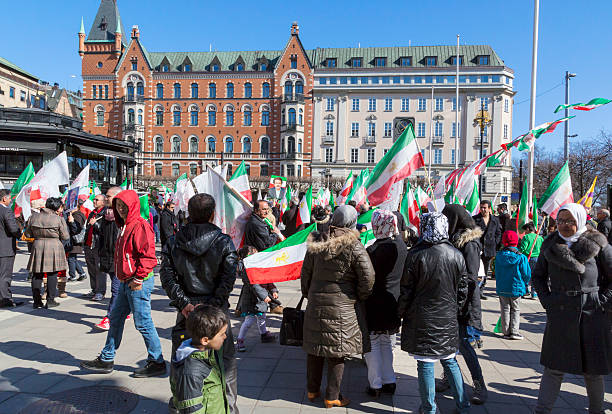
On February 14, 2026, the city of Munich became the scene of a massive demonstration by the Iranian opposition in exile. On the sidelines of the Munich Security Conference, nearly 200,000 people, according to Bavarian police, gathered to denounce the authorities of the Islamic Republic of Iran. The scale of the mobilization, far exceeding initial expectations, went beyond a diaspora protest: it formed part of a broader political strategy aimed at internationalizing Iran’s internal crisis at a moment when global decision-makers were debating major geopolitical challenges.
The choice of location and timing was deliberate. The Munich Security Conference is one of the world’s leading forums dedicated to defense, diplomacy, and global stability. By assembling near high-level discussions involving heads of state, ministers, and strategic policymakers, demonstrators sought to place the Iranian crisis firmly on the international agenda. Their message was clear: the situation in Iran should not be viewed solely as a domestic human rights issue, but as a matter of international security.
The march, which moved toward the vast grounds of Theresienwiese, unfolded largely peacefully. Protesters displayed symbols such as the pre-1979 Iranian flag bearing the lion and sun emblem, signaling a strong rejection of the current regime. This reference to the pre-revolutionary era also highlights deeper debates within the opposition itself: whether Iran’s future should take the form of a republic, a constitutional monarchy, or an entirely new political model. Behind the apparent unity of the crowd lies a diversity of political visions.
The presence of Reza Pahlavi, son of the last Shah of Iran, was particularly notable. Speaking in Munich, he called on the international community and specifically U.S. President Donald Trump to openly support the Iranian people against the ruling authorities. This appeal reflects a clear strategic orientation: securing Western political and diplomatic backing to accelerate regime change. However, such a stance raises complex questions about feasibility, sovereignty, and the potential risks of foreign involvement in an already volatile region.
The Munich demonstration is not an isolated event. Similar rallies have been organized or announced in cities with large Iranian diaspora communities such as Toronto and Los Angeles. This transnational coordination illustrates the mobilization capacity of a dispersed yet interconnected community that uses public spaces in democratic countries to influence international opinion. Exile, in this context, becomes a political instrument.
From an analytical perspective, three major dimensions stand out. First, Iran’s internal crisis is being symbolically exported beyond its borders, turning major Western cities into platforms for political expression. Second, the opposition is strategically linking human rights concerns with broader security considerations, arguing that regional stability depends on political change within Iran. Third, the scale of the gathering suggests a significant erosion of the regime’s legitimacy among parts of the diaspora, even if this does not necessarily reflect the full complexity of public opinion inside the country.
A crucial question remains: what tangible impact will such mobilizations have on the decisions of leaders meeting in Munich? Major powers often balance democratic principles with strategic interests, particularly regarding energy security, nuclear negotiations, and regional stability. While the demonstration represents a symbolic and media success for the opposition, its political effectiveness will ultimately depend on whether governments translate public pressure into concrete policy shifts. In this sense, Munich appears less as a culmination than as a milestone in the ongoing internationalization of a movement seeking to reshape global calculations surrounding Iran.