
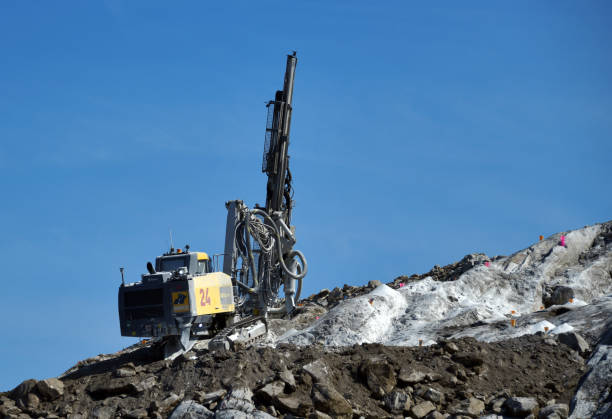
Greenland is increasingly emerging as a key territory in the global debate over access to critical minerals, which are essential for modern technologies and the energy transition. Its subsoil contains a wide range of strategic resources, including rare earth elements, graphite, lithium, nickel, and other metals crucial for the production of batteries, permanent magnets, wind turbines, and electronic equipment. This abundance places the island at the center of economic and geopolitical competition, as major powers seek to secure supply chains and reduce their dependence on dominant producers.
Despite this significant mining potential, Greenland is still far from being a major player in global production. As of January 9, 2026, the extraction of critical minerals remains limited and largely at an exploratory or pilot stage. Existing projects are progressing slowly and struggle to reach the level of profitability required to justify large-scale industrial investment. Compared with other mining regions, Greenland’s deposits often have relatively low concentrations or complex mineral compositions, making extraction and processing particularly expensive.
Natural constraints represent one of the main obstacles. A large portion of the territory is covered by ice, and mineral-rich areas are often located in remote regions that are difficult to access and lack infrastructure. Extreme climatic conditions, a short annual operating window, and the absence of developed transport networks significantly increase logistical costs. The construction of roads, ports, and energy facilities alone requires massive investment for projects whose economic viability remains uncertain.
Beyond technical challenges, major environmental and social issues also come into play. Greenland’s population remains cautious and, in some cases, divided over mining development. While some view mining as an opportunity for economic growth and greater financial autonomy, others fear long-term impacts on fragile ecosystems, natural resources, and traditional ways of life. Concerns over pollution—particularly when mineral deposits are associated with radioactive or toxic elements—continue to fuel public debate and strengthen regulatory oversight.
At the international level, interest in Greenland’s resources is part of a broader context of rising geopolitical tensions. Critical minerals have become strategic assets and tools of economic influence. Governments and regional blocs are intensifying efforts to diversify supply sources, secure access to these materials, and reduce vulnerability to global market disruptions. In this context, Greenland is often seen as a potential alternative supplier, though one that remains largely unexploitable in the short term.
As of 2026, Greenland’s mining future therefore remains uncertain. The territory possesses undeniable advantages, but their realization will depend on several key factors: trends in global mineral prices, technological advances that can lower extraction costs, the development of suitable infrastructure, and broad social acceptance of mining projects. Without these conditions in place, Greenland’s resources are likely to remain more of a strategic promise than an immediate economic reality.
Greenland embodies the paradox of critical minerals in the twenty-first century: an abundance of essential resources constrained by significant technical, environmental, and economic barriers. Caught between geopolitical ambitions, financial realities, and environmental priorities, the island stands at a crossroads, with vast potential whose full realization has yet to be determined.