
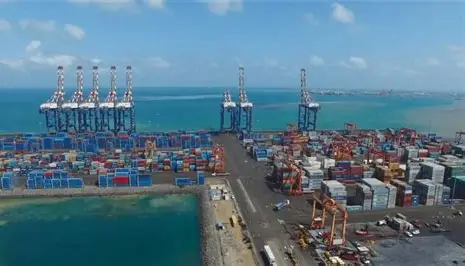
The deepening cooperation between Ethiopia and Djibouti regarding the Doraleh Port marks a significant milestone in the evolving economic and strategic landscape of the Horn of Africa. This initiative occurs within a region profoundly shaped by security tensions, competition among international powers, and the increasing importance of maritime routes connecting Asia, the Middle East, Europe, and Africa.
Landlocked since Eritrea’s independence in 1993, Ethiopia relies heavily on Djibouti’s infrastructure for its international trade. Approximately 95% of Ethiopian imports and exports pass through Djibouti, making the Addis Ababa–Djibouti logistics corridor vital for the country’s macroeconomic stability. In this context, any improvement in port performance directly impacts logistical costs, the competitiveness of agricultural and industrial exports, and the management of strategic supplies such as fuel and essential goods.
For Djibouti, port activity constitutes the backbone of the national economy. Revenues from port services, free trade zones, and logistics operations represent a major portion of public income. Strengthening the relationship with its main client Ethiopia thus secures fiscal sustainability and reinforces Djibouti’s position as a regional hub amid the rise of competing ports in the region, including those in Somaliland and Eritrea.
The announced cooperation also takes place within a broader geopolitical context, marked by instability around the Red Sea and the strategic Bab el-Mandeb Strait. This area hosts significant military and commercial interests: foreign bases in Djibouti, increased international naval presence, asymmetric threats from active armed groups, and evolving regional alliances. In this framework, securing supply chains has become both a strategic and economic priority.
The cooperation focuses on optimizing port operations, improving performance metrics, streamlining customs procedures, and strengthening institutional coordination. The dual objective is to reduce transit times and increase throughput capacity, responding to Ethiopia’s rapid demographic growth and urbanization. The ongoing development of the railway connecting Addis Ababa to Djibouti serves as a key lever in achieving these ambitions.
Diplomatically, this initiative reflects a pragmatic approach by Ethiopia to avoid tensions over its sovereign access to the sea. By consolidating its partnership with Djibouti, Addis Ababa prioritizes economic interdependence over regional confrontation. Ethiopian Ambassador Legesse Tulu emphasized the strategic nature of the partnership and the importance of embedding it within a long-term regional vision.
For Djibouti, the challenge is to maintain a delicate balance among multiple international partners Western powers, Gulf states, and China while preserving the centrality of its relationship with Ethiopia. Diversifying investments and continuously modernizing port infrastructure reinforce Djibouti’s role as an essential hub for East African trade.
Beyond bilateral considerations, this partnership contributes to reshaping the economic architecture of the Horn of Africa. In a region characterized by political transitions, rivalries, and security pressures, logistical and commercial integration emerges as a stabilizing factor. Strengthened cooperation around Doraleh illustrates a shared resilience strategy: securing supply flows, controlling costs, attracting investment, and asserting a pivotal role in one of the world’s most strategic maritime crossroads.
Ultimately, the agreement between Ethiopia and Djibouti transcends mere port modernization. It reflects a strategic adaptation to shifting Red Sea dynamics and confirms that maritime logistics are now central to power relations and development in East Africa.