
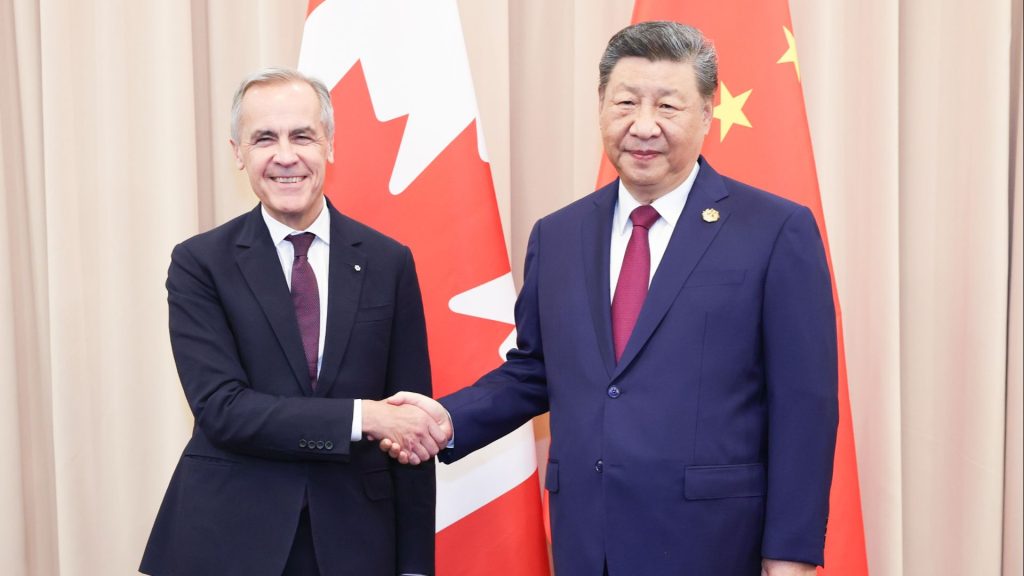
On January 16, 2026, Canada and China announced the launch of a new strategic partnership, described by Canadian Prime Minister Mark Carney as an opportunity for “historic gains” for both countries. The announcement, made in Beijing following a high-level meeting with Chinese President Xi Jinping, marks a significant turning point in bilateral relations long characterized by mistrust, diplomatic tensions, and trade disputes.
This rapprochement comes amid a deeply unstable international context, marked by slowing global growth, increasing fragmentation of trade, and the rise of protectionist policies. For Ottawa, the objective is clear: to diversify its economic partnerships and reduce its excessive dependence on the United States, Canada’s main trading partner but also an increasing source of uncertainty.
Relations between Canada and China had deteriorated sharply from 2018 onward, notably after the arrest in Canada of a senior executive from the Huawei group, followed by Chinese retaliatory measures and trade restrictions targeting several Canadian agricultural products. These tensions severely affected exports, particularly in the canola sector, a cornerstone of Canadian agriculture. The January 2026 announcement therefore appears as a deliberate attempt at gradual normalization and the rebuilding of mutual trust.
At the core of the new partnership are several strategic sectors. Agriculture is one of the main priorities, with the aim of securing and expanding Canada’s access to the vast Chinese market for its grains, oilseeds, and agri-food products. Energy represents another major pillar: discussions cover both traditional resources—oil and liquefied natural gas—and clean technologies and the energy transition, an area in which Beijing is seeking to strengthen international cooperation.
Finance and investment also play a central role in this rapprochement. Mark Carney emphasized the importance of facilitating capital flows, supporting cross-border investment, and strengthening cooperation between financial institutions. For China, the partnership provides privileged access to a country rich in natural resources and politically stable; for Canada, it is a way to attract capital and stimulate growth in an uncertain global economic environment.
This rapprochement is not without controversy and limitations, however. Several trade disputes remain unresolved, particularly regarding tariffs and Chinese industrial policies. In Canada, some political leaders and experts have expressed reservations, highlighting concerns related to human rights, national security, and the protection of strategic sectors. The Carney government has stated its intention to adopt a “pragmatic but vigilant” approach, seeking to balance economic opportunities with political principles.
From a geopolitical perspective, the partnership is being closely watched by Canada’s Western allies. It may signal a broader shift in the economic strategies of several countries seeking to avoid being trapped in rivalries between major powers. Without calling into question its alliance with Washington, Ottawa appears keen to assert a more autonomous and flexible economic diplomacy.
Ultimately, the agreement announced on January 16, 2026 does not represent an abrupt break, but rather the beginning of a gradual process of rapprochement between Canada and China. Its success will depend on both countries’ ability to turn political declarations into concrete and lasting agreements. If successful, this partnership could reshape part of the economic balance between Asia and North America, while illustrating the new pragmatic dynamics shaping contemporary international diplomacy.