
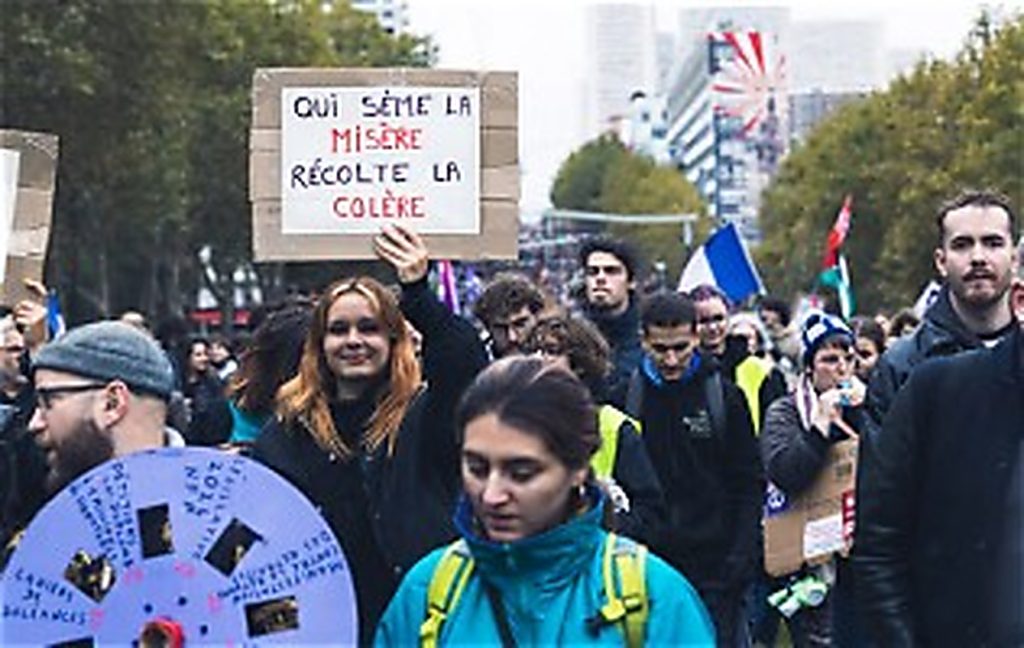
France experienced another day of social mobilization on Saturday, October 31, 2026, as several trade unions, student and high school organizations, as well as the Yellow Vests movement, called for demonstrations. Described as the third major wave of protests against the rising cost of living, the demonstrations took place in numerous cities across the country, amid growing social discontent over purchasing power, living conditions and the future of younger generations.
According to figures released by the French Interior Ministry, approximately 15,000 people had taken part in demonstrations across France by the afternoon. Authorities had nevertheless anticipated a significant turnout, with nearly 150 gatherings scheduled nationwide. This latest mobilization follows the October 24 demonstrations, which attracted between 410,000 and 800,000 participants, according to estimates reported in Le Monde‘s live coverage.
In Paris, the demonstration route became the subject of several developments even before the gathering began. The Paris police headquarters had initially banned the routes proposed by the inter-union coalition in the city center, favoring an alternative route along the outskirts of the capital, between Porte de Bagnolet and Porte de Charenton. However, the administrative court suspended the order prohibiting the trade unions’ proposed route between Place de la Bastille and Place de la Nation. This decision prompted an appeal before the Council of State, creating uncertainty over the organization of the march.
Ultimately, the Paris demonstration set off from Porte de Bagnolet along the authorized route. By mid-afternoon, the procession was moving forward in a generally peaceful atmosphere, accompanied by chants and whistles. Despite the presence of law enforcement officers and aerial surveillance provided by a helicopter, no major incidents had been reported in the area at that point.
The demonstrations were not limited to the capital. In Grenoble, several protesters denounced police violence through banners and slogans. The gathering, which started near the railway station, was marked by clashes between some young demonstrators and law enforcement officers near an avenue in the city center where demonstrations had been prohibited. Police officers charged at protesters and used tear gas, causing the procession to split. Some students explained that police violence and injuries sustained by young people were among the main reasons for their participation.
In Marseille, several hundred people also gathered at Place des Réformés despite a ban on the demonstration. The crowd included high school students, university students, families and elderly people. Their demands focused particularly on the difficulties facing young people, access to sufficient food, study conditions and the ability to live with dignity. After gathering for nearly an hour, the protesters headed towards Longchamp Park under close surveillance by the Republican Security Companies (CRS).
In Lille, the demonstrations also took on a broader dimension, extending beyond economic and educational concerns. Participants expressed their fears about rising racism, difficulties accessing employment and the deteriorating prospects facing younger generations. Several demonstrators denounced the challenges graduates encounter when trying to find jobs matching their qualifications, as well as difficulties related to housing and purchasing power. Marine Tondelier, national secretary of the Green Party, who attended the Lille demonstration, described the mobilization as an important step ahead of the general strike scheduled for November 5.
Young people have become a central focus of this movement. After six weeks of mobilization, student and high school organizations believe that the government’s responses remain insufficient. They are particularly critical of the lack of concrete measures addressing educational conditions, employment prospects and the financial difficulties faced by young people. Before the Paris march began, Sabrine Kharbach, spokesperson for the Student Union, called for further blockades of schools and universities starting Tuesday, November 3. The aim is to maintain pressure ahead of the November 5 strike, which has been called by workers and trade union organizations.
In response, the government strengthened its security arrangements. Interior Minister Laurent Nuñez had announced the deployment of nearly 70,000 police officers and gendarmes nationwide. The extensive security operation included mobile units, specialized forces such as the BRI, RAID and GIGN, as well as drones, helicopters, police dog units and armored vehicles belonging to the gendarmerie. Authorities justified these measures by pointing to the risk of unrest, property damage and looting, particularly in commercial areas. The minister also warned that demonstrations would be permitted under certain conditions, with authorities favoring locations on the outskirts of cities rather than areas considered sensitive in city centers.
At 2 p.m., the Interior Ministry had counted 15,000 demonstrators taking part in 65 separate actions across the country. Authorities described the situation as generally calm, although 27 arrests had been made. By comparison, 37,000 participants had been recorded at the same time on Saturday, October 24, during 108 separate actions. These figures indicate lower participation at that stage of the day, although demonstrations were still underway in several cities.
Meanwhile, Education Minister Édouard Geffray had sent a letter to high school students on Friday evening, on the eve of the new demonstrations and just days before schools reopened. In his message, he emphasized the importance of education, personal development and academic success. This initiative comes as student organizations continue to argue that the government’s commitments do not adequately address their concerns.
Beyond the October 31 demonstrations, the movement could therefore continue in the coming weeks. Calls for school and university blockades, the prospect of a November 5 general strike and an initiative by the Yellow Vests movement to organize a national assembly of social movements on November 21–22 or November 28–29 all point to efforts to coordinate the different protest movements. The initiative aims in particular to bring together trade unions, citizens’ groups and other organizations involved in the demonstrations.
The October 31 mobilization therefore highlights the persistence of widespread social discontent that is gradually extending beyond the issue of the rising cost of living. Concerns about education, employment, public services, inequality and living conditions are contributing to a broader set of demands. Although participation figures released by the authorities remained lower than those recorded at the same time during previous demonstrations, continued calls for mobilization suggest that France could face further social tensions in the coming weeks.
