
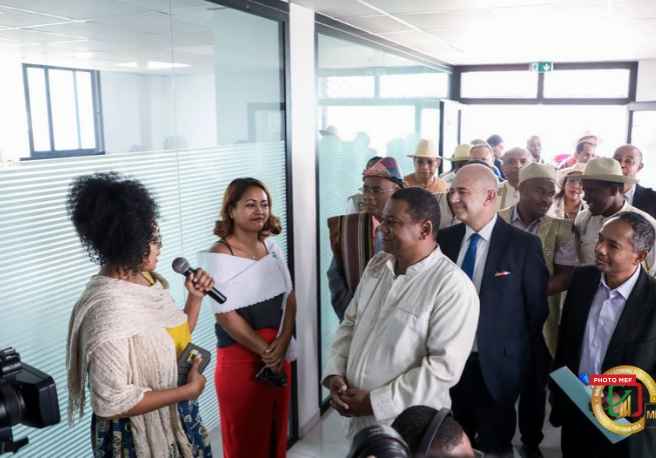
To address this issue, the tax administration has established a new contact center designed to inform, guide, and assist taxpayers with their administrative procedures. Inaugurated on October 23, 2026, the service operates under the General Directorate of Taxes and aims to provide information on tax legislation and administrative requirements. Approximately 30 staff members have been assigned to answer taxpayers’ questions and help them better understand their obligations. During the inauguration, Zo Razafindrakoto, Chief of Staff at the Ministry of Economy and Finance, emphasized that these figures demonstrate the considerable efforts still required to improve taxpayer support.
Through this initiative, the authorities are focusing on making tax information more accessible to facilitate compliance with filing and payment requirements. Complex administrative procedures and limited understanding of tax regulations can create obstacles for some taxpayers, particularly small businesses and informal-sector operators seeking to formalize their activities. By providing a more accessible information service, the DGI aims to improve taxpayers’ understanding of tax procedures and encourage more people and businesses to fulfill their obligations.
However, the challenge extends beyond providing information. Broadening the tax base and strengthening tax collection are essential to increasing government revenue and financing public policies. Greater tax compliance could help raise revenue without relying exclusively on introducing new taxes or increasing existing tax rates. Promoting a stronger tax compliance culture is therefore an important way to strengthen the government’s ability to mobilize domestic resources.
This priority is also reflected in the country’s budget forecasts. For 2027, domestic tax revenue is projected to reach 6,721.6 billion ariary, compared with 6,221.7 billion ariary forecast for 2026. This represents an increase of 499.9 billion ariary, equivalent to approximately 8.03%. By comparison, projected domestic tax revenue rose from 5,628.4 billion ariary in 2025 to 6,221.7 billion ariary in 2026, representing an increase of approximately 10.54%.
In this context, the main challenge for Madagascar’s tax administration is to turn taxpayer registration into effective participation in public financing. The new contact center represents an effort to bring the administration closer to taxpayers, but its effectiveness will depend on its ability to simplify procedures, provide reliable guidance, and encourage compliance. Improving tax collection sustainably is therefore crucial to strengthening government revenue and supporting Madagascar’s development objectives.