
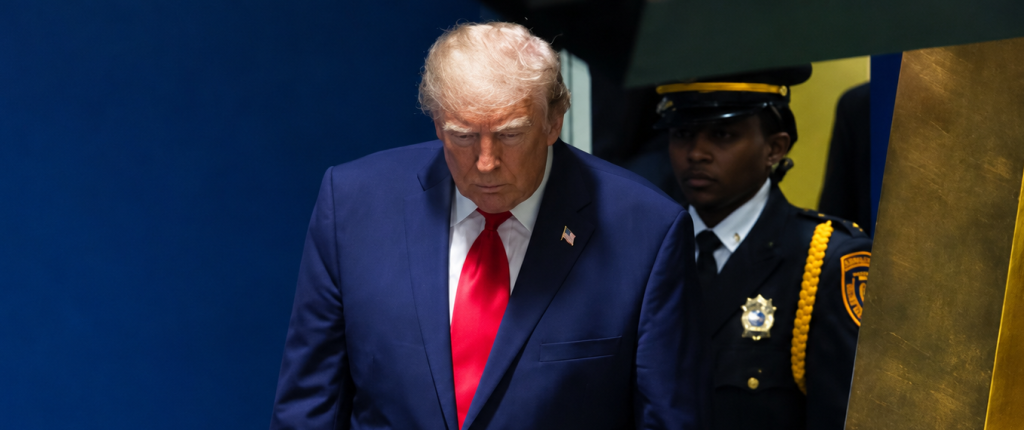
U.S. President Donald Trump placed the conflict with Iran at the center of his address to the United Nations General Assembly in New York on Tuesday, September 22, 2026. In a speech focused on U.S. foreign policy and major international conflicts, Trump said he faced a “big decision” over the future of relations with Tehran: reaching an agreement that would allow Iran to rebuild, or escalating the confrontation to the point of “annihilating” the Islamic Republic.
Donald Trump presented this stark alternative as the conflict between the United States and Iran continues. The U.S. president defended Washington’s decision to become directly involved in the war, arguing that one of the main objectives was to prevent Iran from obtaining a nuclear weapon. He also accused the Iranian authorities of attempting to delay negotiations and called on other countries to increase economic pressure on Tehran in order to bring it back to the negotiating table.
Despite the harsh tone of his remarks, Trump also said he expected diplomatic developments. He indicated that a deal with Iran could potentially be reached after the U.S. midterm elections scheduled for November 3. According to Trump, such an agreement could eventually allow Iran to rebuild and open the way toward a different relationship between Washington and Tehran. The diplomatic possibility therefore exists alongside the threat of further military escalation.
The Iranian issue comes amid particularly high tensions across the Middle East. The conflict has already affected energy supplies and international oil markets, while the situation surrounding the Strait of Hormuz remains a major concern for global energy trade. French President Emmanuel Macron has discussed with Trump several initiatives concerning the reopening of the strait and increasing oil supplies in an effort to limit the economic consequences of the crisis.
Trump’s speech also triggered a visible reaction from the Iranian delegation at the United Nations. According to several media reports, members of the Iranian delegation left the chamber during the American president’s address, highlighting the depth of the diplomatic tensions between Washington and Tehran.
Beyond Iran, Trump devoted a significant part of his speech to his broader vision of U.S. foreign policy. He addressed several other international issues, including Venezuela, Cuba, Mexico and the war in Ukraine. He also renewed his criticism of the International Criminal Court and certain United Nations institutions, while maintaining that the United States would not allow international organizations to prosecute American military personnel.
The Iranian issue is expected to remain a central topic of diplomatic discussions in New York during the high-level week of the 81st session of the United Nations General Assembly. Around 130 heads of state and government are attending the high-level meetings in person, while numerous bilateral discussions are taking place on the conflicts in the Middle East and Ukraine.
Trump’s statements do not, at this stage, amount to an announcement of a definitive decision on the future of the conflict. Rather, they indicate that Washington is maintaining two possible paths at the same time: negotiations with Tehran if an agreement can be reached, and the possibility of further escalation if diplomatic efforts fail. The next developments will depend on negotiations, Iran’s response and the military situation across the region.
