
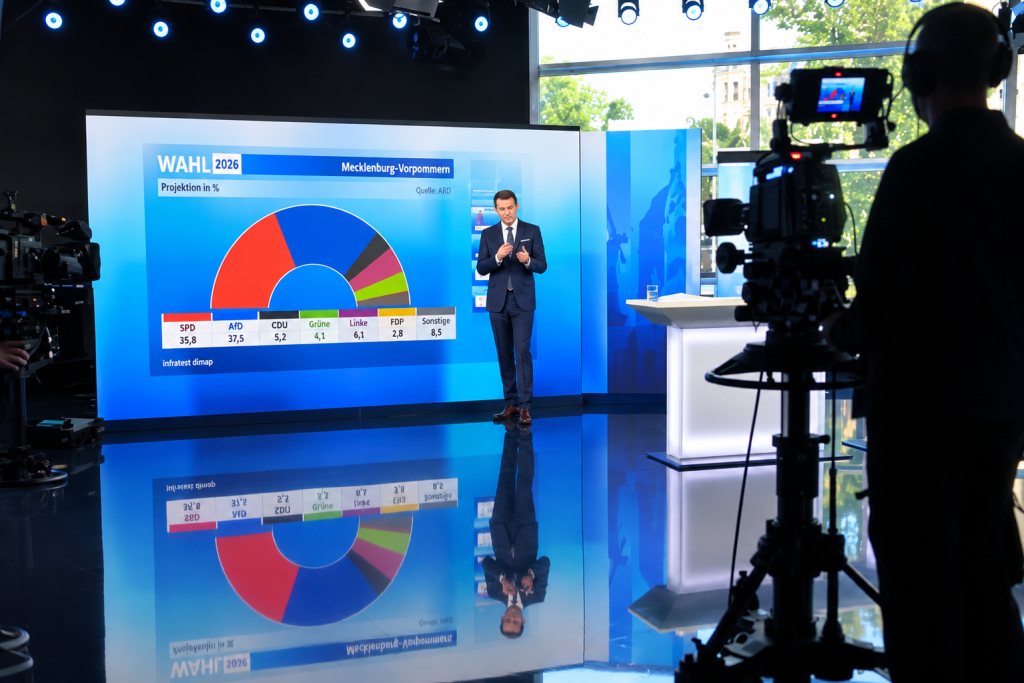
Regional elections held on Sunday, September 20, 2026, in Mecklenburg-Western Pomerania have marked a significant advance for the Alternative for Germany (AfD), a party widely classified as far-right. According to initial projections based on exit polls conducted by Germany’s public broadcasters ARD and ZDF, the AfD is expected to receive between 37% and 38% of the vote, compared with 16.7% in the 2021 regional election. These initial estimates place the party in first place in the northeastern German state.
The AfD is narrowly ahead of the Social Democratic Party (SPD), which has governed the state since 1998. The SPD, led at the regional level by Minister-President Manuela Schwesig, is projected to receive approximately 35.5% to 36.5% of the vote, compared with 39.6% in 2021. The gap between the two parties therefore remains relatively small, but the AfD’s increase is particularly significant compared with its previous result.
The development comes only two weeks after another strong performance by the AfD in Saxony-Anhalt, another state in eastern Germany. Its successive results in these regions highlight the party’s growing electoral presence in several parts of the former East Germany. Mecklenburg-Western Pomerania has approximately 1.6 million inhabitants and is located along Germany’s Baltic Sea coast.
Despite coming first, the AfD is not expected to be able to form a regional government on its own. The main other political parties have ruled out cooperation with the AfD. Winning the largest share of the vote therefore does not automatically mean that the party will be able to govern the state. The formation of the next regional majority could require negotiations between several political parties.
The election also represents a significant setback for the Christian Democratic Union (CDU), the party of Chancellor Friedrich Merz. Initial projections put the CDU at around 5% to 5.5%, compared with 13.3% in 2021. The party is therefore very close to the 5% electoral threshold required to secure seats in the regional parliament.
Friedrich Merz described the CDU’s result as an “electoral disaster” while reaffirming his intention to continue with his reform agenda. The result comes as the chancellor faces growing political difficulties following the CDU’s decline in Saxony-Anhalt and increasing pressure within his own party.
The September 20 elections also include Berlin, where the AfD is also making gains, although the political context is different. Initial projections place Die Linke in first place, ahead of the CDU, while the AfD is recording a higher result than in the previous regional election.
These regional elections do not directly determine the composition of Germany’s federal government, but they provide an important indication of changing political dynamics across the country. The AfD’s gains in several eastern states come amid debates over economic reforms, difficulties facing the federal government and declining support for several traditional political parties. The final results and the negotiations required to form a governing majority will determine the political and institutional consequences of the election in Mecklenburg-Western Pomerania.
