
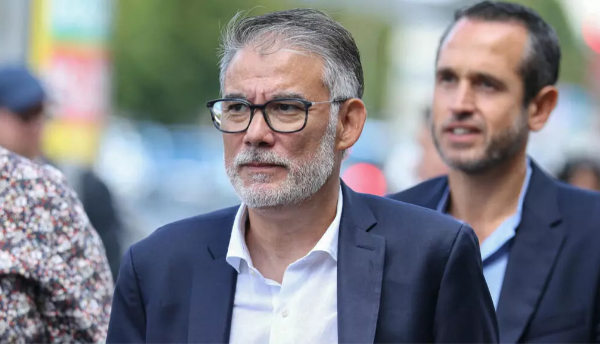
As France’s 2027 presidential election approaches, the Socialist Party is once again facing deep internal tensions. Meeting in Blois for its summer gathering, Socialists are seeking to preserve party unity, but preparations for the social-democratic primary are exposing major strategic disagreements. At the center of the tensions is Olivier Faure, the party’s first secretary, who is facing growing pressure from within his own ranks to enter the race for the nomination.
The situation has become particularly tense following Raphaël Glucksmann’s official entry into the presidential race. The leader of Place publique has announced his candidacy and is expected to take part in the primary scheduled for the autumn. He has already secured the backing of several prominent Socialists opposed to Olivier Faure, including Boris Vallaud, president of the Socialist group in the National Assembly, as well as Carole Delga and Nicolas Mayer-Rossignol. This growing support has placed the Socialist Party’s first secretary in a difficult position as he continues to consider the strategy he intends to pursue.
Olivier Faure has not yet officially declared his candidacy for the primary, but his participation now appears increasingly likely. He has until September 15 to formally enter the race. During the Socialist Party’s summer gathering in Blois, he chose to emphasize party unity rather than immediately announce his decision. He nevertheless stressed that he wants the primary to become a genuine democratic process, calling for serious political debate rather than a destructive internal confrontation.
The disagreement also concerns the very nature of the primary. Olivier Faure initially supported a broadly open process involving left-wing supporters, while Socialist Party members ultimately favored a more limited primary bringing together mainly the Socialist Party and Place publique. The decision represents a setback for Faure and reflects the growing influence of his internal opponents.
Facing him, Raphaël Glucksmann has emerged as one of the leading contenders for the nomination. His candidacy has gained significant momentum within the social-democratic camp, although his lead remains uncertain and opinion polls do not guarantee a final victory. The contest between the two men could therefore become the central issue of the primary, with two different visions for the future of the French left. Glucksmann represents a more explicitly social-democratic approach, while Faure advocates a broader strategy aimed at bringing together different sections of the left and the Greens.
Olivier Faure is also relying on his ability to maintain dialogue with the Greens. He says he remains in regular contact with Marine Tondelier and wants to preserve the possibility of closer cooperation between Socialists and environmentalists after the primary. This strategy could help him mobilize voters and activists who favor a candidate capable of bringing together a broader section of the left, while Raphaël Glucksmann could face greater difficulties in securing support from some Green leaders.
The challenge for Olivier Faure is also electoral. After several years at the head of the Socialist Party, he must demonstrate that he has the ability to embody the French left in a presidential election. His internal opponents argue that his position as first secretary is not enough to make him a natural candidate for the Élysée Palace. His supporters, however, believe that the primary could give him an opportunity to turn his strong position within the party into genuine electoral momentum.
The battle therefore goes far beyond the simple question of choosing a presidential candidate. It could determine the future direction of the Socialist Party, its relationship with the Greens and other left-wing movements, and its ability to build a common candidacy ahead of the 2027 election. With the French left still deeply fragmented and several political figures yet to clarify their presidential ambitions, the outcome of the primary could significantly reshape the balance of power on the left.
In Blois, Olivier Faure is therefore attempting to prevent a confrontation that could leave lasting divisions within the party. But behind the calls for unity, the competition with Raphaël Glucksmann is already underway. For the Socialist Party’s first secretary, the coming weeks will be crucial. He will have to clarify his candidacy, convince Socialist activists and demonstrate that he can offer a credible strategy for bringing the left together ahead of the 2027 presidential election.