
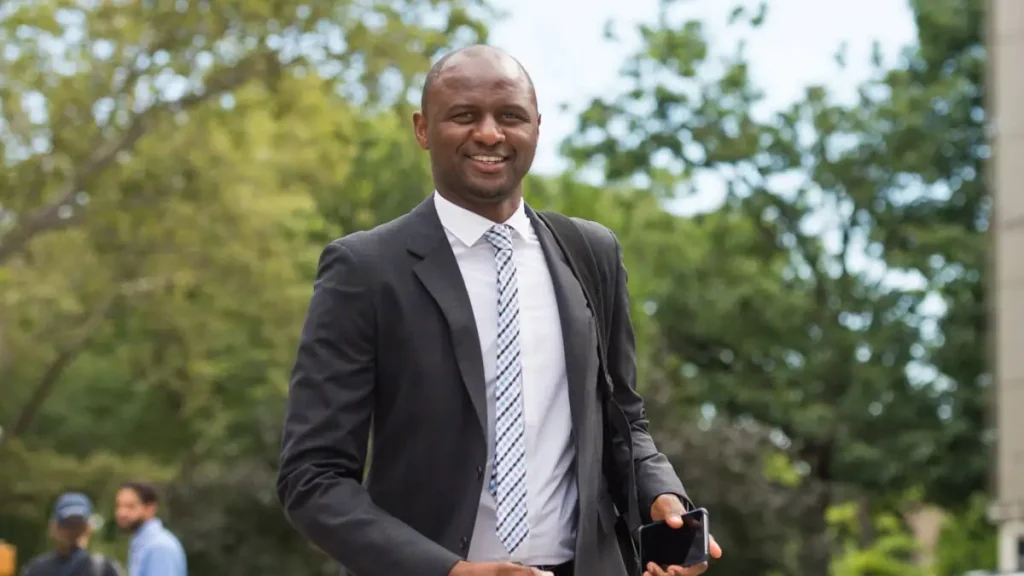
The Senegalese Football Federation (FSF) officially appointed Patrick Vieira as the new head coach of the national senior team on August 18, 2026. The former French international, a 1998 World Cup winner and a native of Dakar, succeeds Pape Thiaw and takes charge of the Lions of Teranga at a decisive moment for Senegalese football. For the FSF, this appointment is more than simply a change of coach: it represents a “strategic choice” aimed at opening a new chapter in the development and management of the national team.
The decision was unanimously approved by the FSF Emergency Committee, which met in an extraordinary session by videoconference on August 17. It comes just weeks after Pape Thiaw left his position following Senegal’s elimination from the 2026 FIFA World Cup. The Lions reached the Round of 16 before being knocked out, bringing Thiaw’s tenure to an end and prompting the federation to seek a new direction.
The appointment of Patrick Vieira is particularly symbolic. Born in Dakar and raised in France from a young age, the 50-year-old coach has enjoyed an exceptional career in international football. As a player, he represented France at the highest level and won the 1998 FIFA World Cup and UEFA Euro 2000. He also became one of the most influential figures at Arsenal, where he made more than 400 appearances and won three Premier League titles. His career later took him to Inter Milan and Manchester City.
After retiring from professional football, Vieira gradually moved into coaching. He worked with Manchester City’s youth development system before taking charge of New York City FC. He subsequently managed several European clubs, including OGC Nice in France, Crystal Palace in England, Strasbourg and Genoa. His experience across different football environments is one of his major assets as he begins his first role as a national-team head coach.
This international experience is one of the key reasons behind the FSF’s decision. The Senegalese federation wants to establish a high-level technical structure and take another step forward in the development of its national team. Bringing in a coach who has experienced elite football both as a player and as a manager is expected to provide Senegal with a different perspective, particularly in preparing for major international competitions and managing a squad made up largely of players competing in top European leagues.
However, Vieira takes over at a time when expectations are particularly high. Senegal remains one of Africa’s leading football nations and won the Africa Cup of Nations in 2022. The team also boasts an experienced squad, with several players competing in Europe’s major leagues. The FSF will therefore expect the new coach to maintain Senegal’s status among the continent’s leading teams while gradually preparing the next generation.
Pape Thiaw’s departure also marks the end of a turbulent period. Appointed head coach of the national team in December 2024, Thiaw helped Senegal secure qualification for the 2026 World Cup. His tenure was nevertheless marked by challenges, including controversies surrounding the 2025 Africa Cup of Nations and the team’s performances at the World Cup. Following Senegal’s elimination in the Round of 16, the FSF ultimately decided to turn the page and place its trust in a new technical project.
For Vieira, the challenge will therefore be twofold: delivering results quickly while building a team capable of remaining competitive over the long term. His arrival comes as Senegal must already look ahead to the next Africa Cup of Nations. The qualification campaign for AFCON 2027 is scheduled to begin in September, giving the new coach relatively little time to assess his players, establish his priorities and implement his footballing philosophy.
Senegal’s first fixtures under Vieira will therefore be closely watched. The team is scheduled to face Mozambique on September 23 in the AFCON 2027 qualifying campaign. This match could provide Vieira with his first opportunity to make his mark on the team and introduce his approach. Senegal’s qualifying group also includes Mozambique, Sudan and Ethiopia.
Beyond immediate results, the FSF appears determined to make Vieira’s appointment part of a longer-term strategy. Reports indicate that the objectives associated with his project include achieving a strong performance at AFCON 2027 and securing qualification for the 2030 FIFA World Cup. These ambitions demonstrate the level of confidence placed in the new coach and the federation’s desire to establish a project that extends beyond a single tournament.
Vieira’s appointment also carries an important identity dimension. The new Senegal coach was born in Dakar, although his international career was built under the French flag. His dual cultural and sporting background could prove valuable in his relationship with Senegalese supporters and players. Nevertheless, results on the pitch will remain the ultimate measure of his success.
Another major challenge will be managing the transition between generations. Senegal has several experienced leaders, but the national team must also prepare for the emergence of younger players. Vieira’s experience working with young footballers, particularly during his time within Manchester City’s development system, could help him manage this transition and integrate new talent into the senior squad.
From a tactical perspective, his arrival could also bring a fresh approach. Vieira has developed a reputation for emphasizing collective organization, technical quality and the demands of modern football. However, he will need to adapt his methods to the characteristics of Senegalese football and to the specific strengths of his squad. His success will therefore depend not only on his coaching ability but also on his capacity to understand the environment of African international football and build a strong collective identity.
The pressure surrounding the new coach will nevertheless be considerable. Senegal has established itself as one of Africa’s football powerhouses, and supporters expect performances that match this status. Vieira’s international reputation and prestigious playing career will only increase expectations. The former World Cup winner will therefore have to convert his experience and leadership into tangible results as quickly as possible.
For the Senegalese Football Federation, the objective is clear: use the arrival of a high-profile international coach to take the national team to another level. The FSF has presented Vieira’s appointment as part of its ambition to strengthen the technical leadership of the national team and establish a sustainable high-performance project.
Patrick Vieira therefore begins his first experience as a national-team coach with an ambitious mission. Between the AFCON 2027 qualifiers, the rebuilding of the team following the 2026 World Cup and preparations for future international competitions, he will have little time to settle in. His return to Senegal, more than three decades after leaving Dakar, therefore carries a special significance. He is no longer simply representing the country where he was born; he is now responsible for leading the Lions of Teranga toward a new continental and international ambition.
Ultimately, the success of Vieira’s project will depend on his ability to transform his experience, leadership and international background into genuine collective momentum. The FSF has chosen a coach with an impressive career to begin a new chapter. The first results, particularly in the AFCON 2027 qualifying campaign, will quickly provide an indication of whether this “strategic choice” can deliver the new momentum Senegalese football is seeking.