
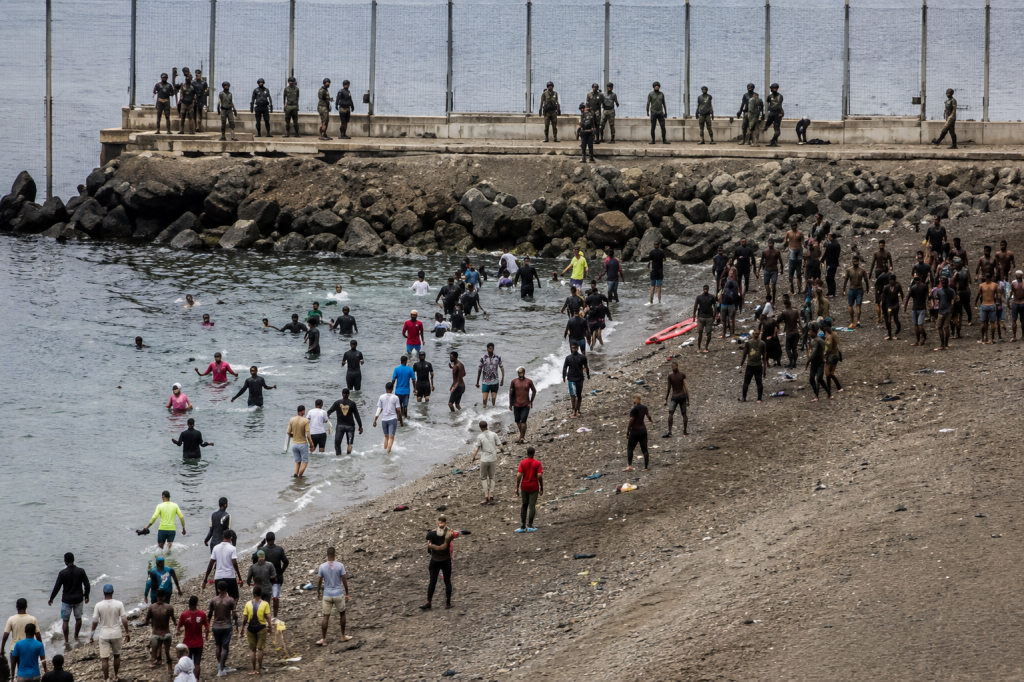
The migration situation remains extremely tense in Ceuta, the Spanish enclave located on Morocco’s northern coast, following the mass arrival of migrants at the end of July. More than 72,000 people reportedly attempted to reach Spanish territory during the major surge, making it one of the most serious migration crises ever recorded in the enclave. At least 140 people are believed to have died during the attempt, according to estimates reported by several media outlets.
Several thousand migrants remain in Ceuta in particularly precarious conditions. Estimates range from around 5,000 to 8,000 people still present in the enclave, including many unaccompanied minors and asylum seekers. As reception facilities have become overwhelmed, some migrants have staged protests, notably on El Trampolín beach, demanding the right to apply for asylum in Spain and opposing possible returns to Morocco.
The crisis also represents a major humanitarian challenge for the Spanish authorities. Accommodation facilities and local services are under severe pressure, while thousands of people have already required medical assistance. In response to the emergency, the Spanish government announced the creation of four additional temporary reception facilities, providing around 1,500 places. The Spanish military is helping to set up these facilities, including one designed to accommodate more than 1,000 asylum seekers currently in vulnerable situations.
At the same time, Madrid is seeking to prevent another large-scale arrival. Morocco has significantly strengthened security measures around Fnideq, a city located immediately next to Ceuta. Moroccan authorities recently intercepted nearly 300 people attempting to approach the border, including migrants from sub-Saharan Africa and Moroccan nationals suspected of facilitating their movements. The operation came after calls for another mass attempt to cross the border circulated on social media.
Morocco therefore plays a central role in controlling a border that represents one of the main land gateways to Europe from Africa. For Spain and, more broadly, the European Union, cooperation with Rabat is essential to limiting irregular arrivals. However, the situation also raises questions about how responsibility for migration control should be shared between the two sides and about the financial and political resources devoted to border management. The Spanish government’s decision not to deploy Frontex to Ceuta, despite an offer of support from European agencies, illustrates the continuing debate over how the crisis should be managed.
The diplomatic dimension of the crisis should not be overlooked either. Morocco continues to regard Ceuta and Melilla as Moroccan territories, while Spain maintains its sovereignty over both enclaves. The recent migration crisis has therefore revived longstanding tensions between Madrid and Rabat, even though the two countries have strengthened their cooperation in recent years on security and migration issues. Managing migration flows has consequently become a humanitarian, security and diplomatic challenge at the same time.
For the migrants currently stranded in Ceuta, the future remains highly uncertain. Some are seeking asylum and hope to remain in Spain, while others could face return to Morocco depending on their legal status. More than simply a border crisis, the events in Ceuta highlight the European Union’s continuing difficulty in reconciling border control, cooperation with transit countries, and respect for asylum law and migrants’ fundamental rights.