
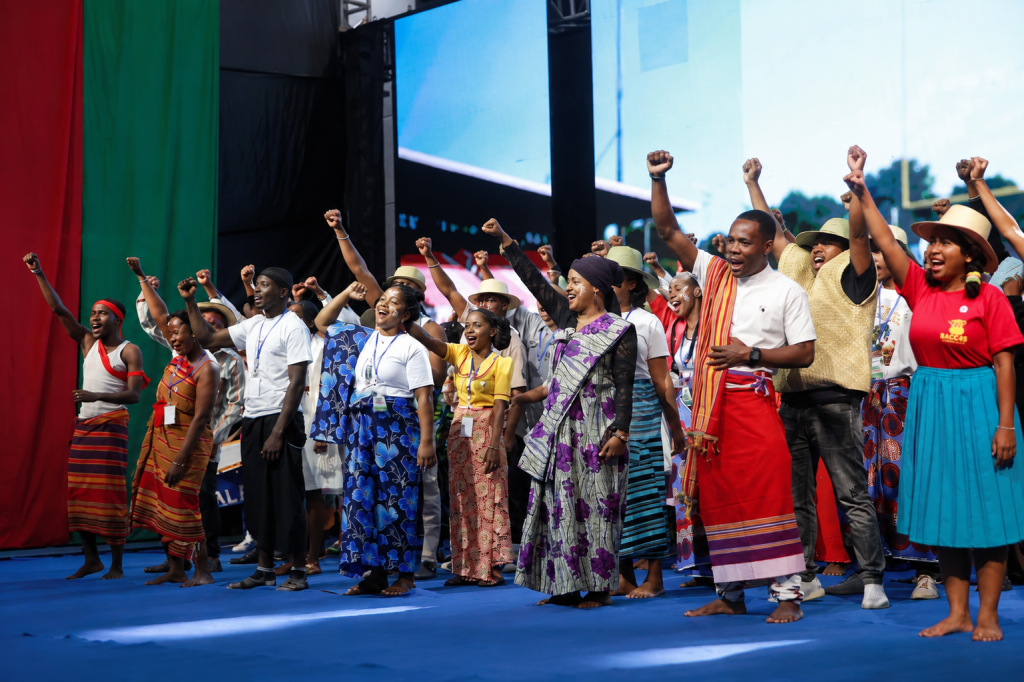
Madagascar’s National Youth Consultation, held from July 29 to August 1, 2026, at the International Conference Center (CCI) in Ivato, concluded with a series of proposals aimed at contributing to the country’s institutional renewal process. Among the most sensitive issues discussed was the structure of the State. After several days of debate, the young participants did not settle on a single model. Instead, they proposed continuing discussions around two options: a strongly decentralized unitary state or a federal state.
The organization of the State and territorial governance generated particularly intense discussions among representatives from Madagascar’s different regions. The debate essentially pitted supporters of greater decentralization within a unitary state against those advocating a more profound transformation through the establishment of a federal system. During the discussions, regional differences also emerged, with some participants from coastal regions appearing more supportive of federalism, while others favored maintaining a unitary state with genuine decentralization.
The final outcome of the discussions reflected these divisions. Eleven regions supported a unitary state, ten backed the federal option, while two favored a regionalized model. The Atsinanana region, meanwhile, chose to remain neutral. The results demonstrate that no definitive consensus has yet emerged regarding the form of the Malagasy State as part of the national renewal process.
In response to the lack of consensus, the young participants proposed holding an “option referendum” that would allow the population to decide between the different alternatives. The aim would be to ensure that such a major institutional choice is not imposed from above but instead determined directly by citizens. The proposal comes at a time when Madagascar is engaged in a broader discussion about institutional reform and the future organization of the country.
Beyond the question of the State’s structure, the resolutions adopted by around 400 young people representing 24 regions cover a wide range of issues. On the political and institutional front, they are calling, among other measures, for the dissolution of the National Assembly and the Independent National Electoral Commission (CENI), as well as a major reform of electoral legislation. They also propose recognizing fokontany as decentralized local authorities and establishing a Youth Parliament to strengthen the participation of young people in public affairs.
The recommendations also address the economy and employment. Participants called for greater support for local producers and for the promotion of youth entrepreneurship, particularly by improving access to financing and establishing mechanisms to provide stronger support to young entrepreneurs and project leaders. The objective is to create a more favorable environment for economic initiatives, investment and job creation.
Education and social development are also key components of the resolutions. The young participants called for the construction of properly equipped housing for teachers, the establishment of a vocational training center in every municipality, and the creation of technical high schools and agricultural colleges in every district. These proposals reflect a desire to bring public services closer to communities and to better address the specific needs of Madagascar’s different regions.
Environmental protection is another important area addressed by the resolutions. The participants called for stronger environmental governance and better enforcement of laws designed to protect natural resources. They also proposed establishing a youth committee dedicated to environmental protection and strengthening safeguards for whistleblowers.
The debate over the form of the State nevertheless remains one of the most consequential issues. Federalism could provide regions with greater autonomy and allow decision-making to be brought closer to local realities. A strongly decentralized unitary state, by contrast, would seek to preserve a unified institutional framework while transferring greater powers and resources to local authorities. Choosing between these two models would therefore require an in-depth assessment of their political, economic, administrative and social implications.
The proposals emerging from the National Youth Consultation do not, at this stage, constitute a final decision on Madagascar’s institutional future. They are expected to contribute to the next stages of the national renewal process. A broader national consultation is also expected to contribute to discussions on institutional reform and the drafting of a future Constitution for a Fifth Republic, with a referendum reportedly envisaged for June 2027.
Through these resolutions, Madagascar’s youth are seeking a stronger role in shaping the country’s political and economic future. The debate between a unitary and a federal state is only one part of a broader reflection on governance, decentralization, institutions, economic development and public services. The next challenge will be to turn these proposals into concrete policy directions and determine to what extent they can be incorporated into Madagascar’s national renewal process.