
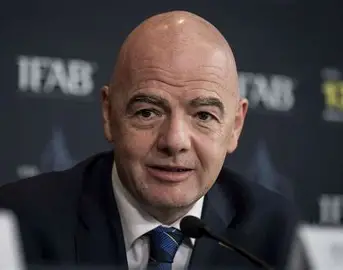
The International Olympic Committee (IOC) has dismissed a complaint filed against FIFA President Gianni Infantino, who was accused of repeatedly violating the Olympic Movement’s rules on political neutrality. The decision, announced on Friday, July 24, comes amid growing criticism over Infantino’s close relationship with U.S. President Donald Trump.
The complaint was submitted earlier this month by FairSquare, a non-governmental organization specializing in human rights and sports governance. The NGO argued that Gianni Infantino had repeatedly demonstrated political support for Donald Trump, claiming that some of his actions were incompatible with the principle of political neutrality upheld by the IOC. FairSquare cited several incidents, alleging that the FIFA president had crossed the boundaries expected of leaders of international sports organizations.
However, the IOC concluded that the allegations did not fall within the jurisdiction of its Ethics Commission. According to the Olympic body, the issues raised primarily concern FIFA’s internal governance and its relationship with government authorities. As a result, they are not covered by the IOC Code of Ethics, even though Gianni Infantino has been an IOC member since 2020.
Importantly, the IOC’s decision does not amount to an endorsement of Infantino’s conduct. The organization did not rule on whether the allegations were true or whether the FIFA president had complied with the principle of political neutrality. Instead, it determined only that it lacked the authority to investigate the matter. In other words, the complaint was dismissed on jurisdictional grounds rather than after an assessment of its merits.
The controversy intensified during the 2026 FIFA World Cup, co-hosted by the United States, Canada, and Mexico. Gianni Infantino’s public appearances alongside Donald Trump, as well as the close relationship displayed between the two leaders, fueled criticism from observers who argued that FIFA’s independence from political influence appeared to be compromised. While FIFA has long maintained that it remains politically neutral, critics believe these repeated interactions have blurred the line between sports governance and political engagement.
One of the most controversial incidents involved U.S. striker Folarin Balogun. After receiving a red card, Balogun was expected to serve a one-match suspension. According to multiple reports, Donald Trump personally asked Gianni Infantino to review the decision. FIFA’s Disciplinary Committee subsequently suspended the enforcement of the sanction for one year, prompting allegations of political interference and preferential treatment.
The case has also sparked reactions within the international football community. The Norwegian Football Federation is reportedly considering filing its own ethics complaint with FIFA, seeking clarification over the decision and raising concerns about the independence and credibility of the organization’s disciplinary process. A decision from the federation’s board is expected in the coming weeks.
Beyond Gianni Infantino’s individual case, the controversy has reignited the broader debate over the role of politics in international sport. Major sporting events have become increasingly significant from diplomatic, economic, and geopolitical perspectives, making interactions between sports leaders and political figures almost unavoidable. However, these relationships become controversial when they create the perception that sporting decisions may be influenced by political interests or personal ties.
Political neutrality remains a fundamental principle designed to protect the independence, fairness, and credibility of international sports institutions. Critics argue that Infantino’s close relationship with Donald Trump risks undermining public confidence in FIFA’s impartiality. Supporters, on the other hand, contend that maintaining constructive relationships with governments is essential for organizing global sporting events of such scale and complexity.
Although the IOC has rejected the complaint, the controversy is far from over. Since the Olympic body declined to investigate the case on jurisdictional grounds, further scrutiny may now shift to FIFA’s own ethics mechanisms. The episode is also likely to strengthen calls for clearer governance rules regarding the relationship between leaders of international sports organizations and political officials.
Ultimately, the IOC’s decision highlights the challenges facing global sports governance. It underscores the difficulty of determining institutional responsibility when senior officials hold positions across multiple international organizations. At the same time, it demonstrates that political neutrality—while widely recognized as a core value of international sport—remains increasingly difficult to uphold in a world where sporting, political, and diplomatic interests are more interconnected than ever.