
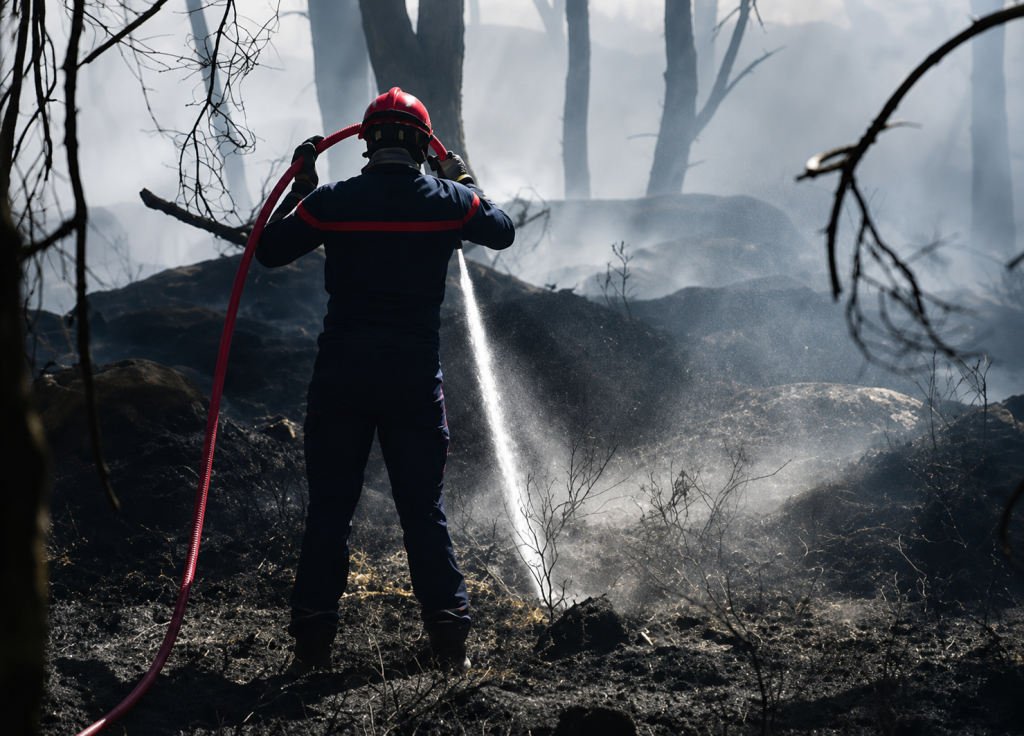
The Fontainebleau Forest, one of the largest and most visited forests in France, has been battling an exceptional wildfire since Sunday, July 12. By Monday, July 13, the blaze had already scorched nearly 1,000 hectares, making it one of the largest wildfires recorded in northern France in the past two decades.
In response to the rapidly spreading fire, French authorities have launched an unprecedented emergency operation for the Paris region. More than 400 firefighters are on the ground, supported by water-dropping helicopters, Dash aircraft carrying fire retardant, and four Canadair firefighting planes. The deployment of Canadair aircraft in the Île-de-France region marks a historic first, highlighting the severity of the situation.
Firefighting efforts have been hampered by challenging weather conditions. Strong and shifting winds, combined with extremely dry vegetation, have fueled the fire’s rapid expansion. Authorities also reported a new fire outbreak near the Faisanderie area, close to Fontainebleau, forcing emergency crews to divide their resources while working to prevent the flames from reaching residential communities.
As a precaution, several evacuations have been carried out. Hundreds of residents have temporarily left their homes, while more than 150 horses were evacuated from the Grand Parquet equestrian center to ensure their safety. The wildfire has also disrupted transportation, causing temporary restrictions on the A6 motorway and interruptions to rail services in the region.
Officials have not ruled out any possible cause of the fire. Because several ignition points were identified within a relatively small area, an investigation has been launched to determine whether the wildfire may have been deliberately started. French Interior Minister Laurent Nuñez confirmed that intentional arson remains one of the scenarios being examined by investigators.
Beyond the immediate emergency, the Fontainebleau wildfire has renewed concerns about the growing frequency and intensity of wildfires across France. Prolonged drought conditions and increasingly frequent heatwaves have significantly heightened wildfire risks. According to French authorities, more than 32,000 hectares have already burned across the country since the beginning of 2026, surpassing the total area affected during the entirety of the previous year.
The disaster serves as another reminder of the mounting challenges posed by climate change and underscores the need for stronger wildfire prevention, improved forest management, and enhanced emergency response capabilities as extreme weather events become increasingly common across Europe.