
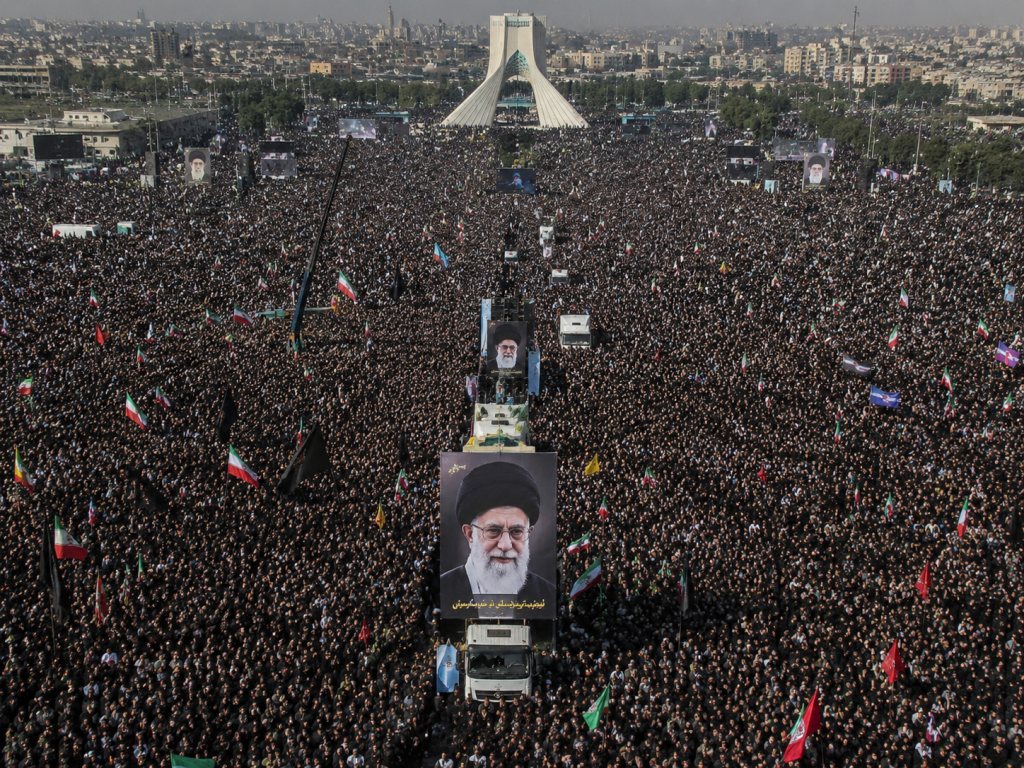
Hundreds of thousands, and possibly millions, of people gathered in central Tehran on Monday to take part in the funeral procession of former Iranian Supreme Leader Ayatollah Ali Khamenei. Held months after his death in a strike attributed to the United States and Israel, the ceremony has become one of the largest public gatherings in Iran’s recent history.
Dressed in black, mourners accompanied the convoy carrying the coffins of Khamenei and several members of his family who were killed in the same attack. Aerial footage broadcast by Iranian state media showed a massive crowd stretching for several kilometers between Enghelab (Revolution) Square and Azadi Square, one of the capital’s most iconic landmarks. Authorities deployed extensive security measures and emergency response teams along the route to manage the large crowds.
The funeral also carried strong political significance. Many participants chanted slogans against the United States and Israel, accusing both countries of orchestrating the assassination of Iran’s former leader. Some demonstrators held banners calling for revenge, while others burned American and Israeli flags during the procession.
Iranian authorities have portrayed the massive turnout as a demonstration of national unity in the face of external pressure. However, many analysts argue that the size of the crowd does not necessarily reflect unanimous support for the government. For many Iranians, attending the funeral was motivated by religious traditions, cultural values, or family ties rather than political allegiance. At the same time, the country continues to face a prolonged economic crisis, high inflation, and ongoing social tensions that have fueled public discontent.
The new Supreme Leader, Mojtaba Khamenei, did not make a public appearance during the procession. According to several reports, he remains under heavy protection after reportedly being injured in the strike that killed his father. His absence has raised questions about Iran’s leadership transition and the future direction of the country’s governance amid an increasingly volatile regional environment.
Following the ceremony in Tehran, the funeral procession is expected to continue through several of Iran’s holy cities before the former leader is laid to rest. The events come as diplomatic efforts concerning the future of relations between Iran, the United States, and Israel remain overshadowed by significant uncertainty and regional tensions.