
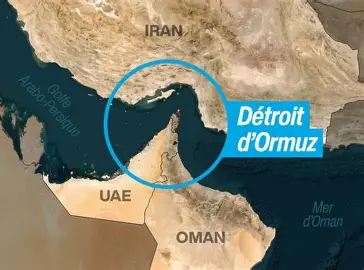
The crisis affecting the Middle East is highlighting China’s energy vulnerability. Beijing is currently trying to unblock maritime traffic related to its interests in the strategic Strait of Hormuz, a vital maritime passage for the global trade of hydrocarbons. The situation illustrates the geopolitical risks faced by the Asian industrial powerhouse, whose economy relies heavily on energy imports from the Gulf.
Located between the Arabian Peninsula and Iran, the Strait of Hormuz is one of the most important chokepoints in the world for energy transport. Around one-fifth of global oil consumption passes through this narrow waterway every day, along with a significant share of liquefied natural gas shipments. Any disruption in this strategic corridor therefore has immediate consequences for international energy markets and global supply chains.
For China, the stakes are particularly high. The country is currently the world’s largest importer of oil, and a substantial portion of its energy supplies comes from the Middle East. Nearly 45% of China’s oil imports transit through the Strait of Hormuz, making the Chinese economy especially exposed to military tensions and maritime disruptions in the region.
In this context, disruptions to maritime traffic have significantly reduced the number of ships crossing the strait. While dozens of oil tankers normally pass through the corridor each day, the flow has dropped sharply, with only a handful of vessels sometimes managing to cross. Hundreds of ships have reportedly been delayed or forced to wait in the Gulf as shipping companies fear potential attacks or incidents in what has become an extremely sensitive area.
Faced with this situation, Beijing has intensified diplomatic efforts to secure its energy supply routes. Chinese authorities have reportedly engaged in discussions with Tehran in an attempt to obtain guarantees that vessels carrying oil destined for China will be able to pass safely through the strait. This strategy relies partly on the relatively strong economic relationship between China and Iran, as Beijing remains one of the major buyers of Iranian crude oil.
In some cases, commercial ships have even adopted unusual tactics in order to cross the area safely. Certain vessels have explicitly indicated their Chinese management or ownership in their maritime identification signals in the hope of avoiding being targeted or intercepted. Such practices highlight the level of tension currently prevailing in the region and the complexity of conducting commercial operations in this crucial energy corridor.
At the same time, China is seeking to maintain a cautious diplomatic position. Unlike some Western powers that maintain a military presence in the region, Beijing continues to prioritize a primarily diplomatic and economic approach. Chinese officials regularly call for the protection of freedom of navigation and for de-escalation, while avoiding direct military involvement in the crisis.
Nevertheless, the situation exposes a structural vulnerability in China’s energy strategy. Despite efforts to diversify its suppliers—particularly toward Russia, Africa, and other regions—the country remains highly dependent on Gulf hydrocarbons. China has built significant strategic petroleum reserves capable of covering several months of consumption, but a prolonged disruption of maritime traffic could still have serious consequences for its economy and industrial production.
Beyond China’s case, the situation in the Strait of Hormuz also highlights the fragility of the global energy system. Disruptions to shipping routes have already contributed to rising oil prices and increasing maritime transport costs. International markets are therefore closely monitoring developments in the region, aware that a prolonged blockage of this strategic corridor could trigger a major global energy shock.
China’s attempt to unblock shipping traffic in the Strait of Hormuz ultimately reflects a broader geopolitical challenge: the security of global energy routes. In a world where energy demand remains high and geopolitical tensions are multiplying, control and protection of strategic maritime passages have become more crucial than ever for maintaining global economic stability.